

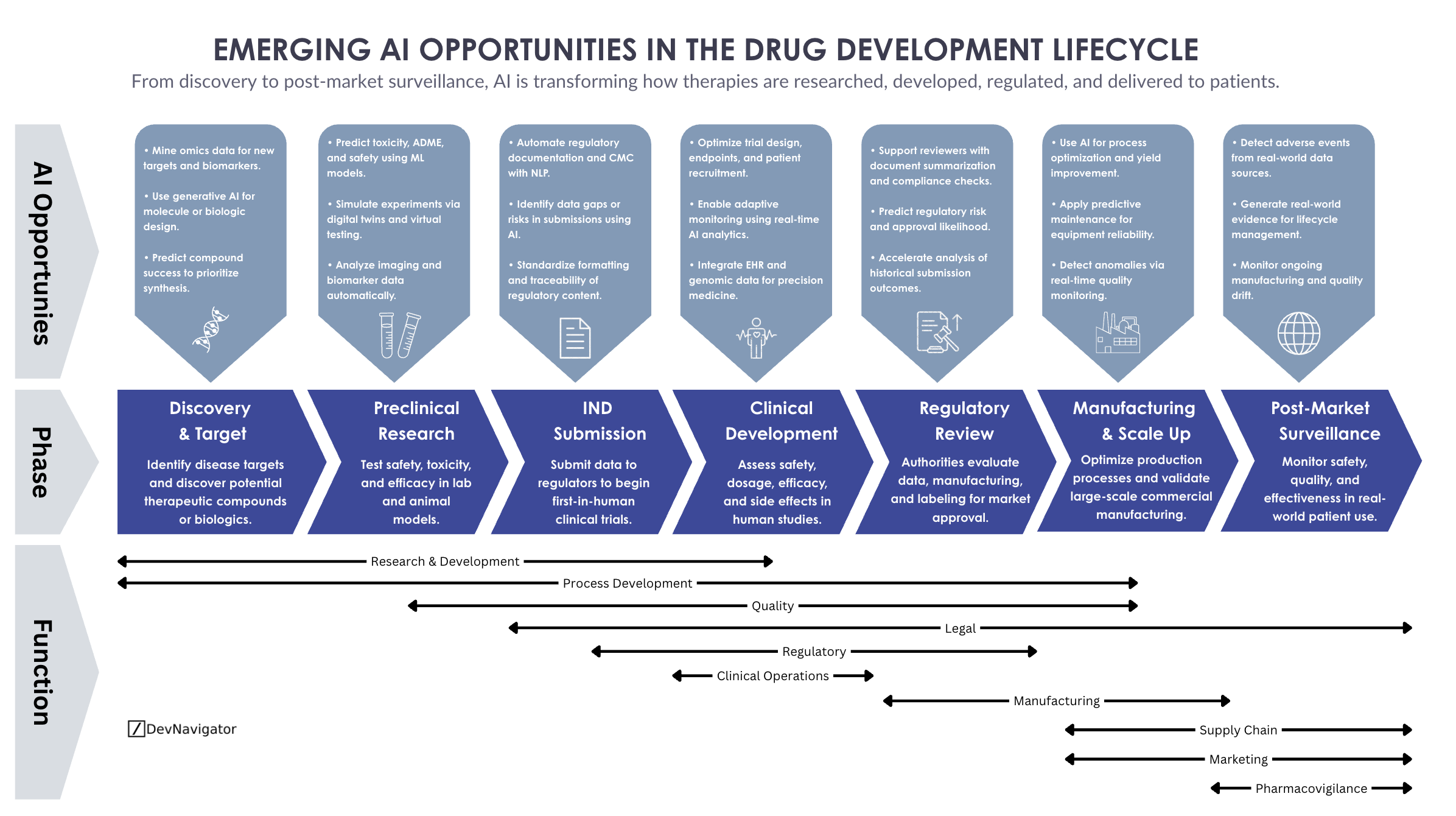
AI in drug development lifecycle is no longer experimental or speculative. It is becoming a practical, production-grade capability that influences how therapies are discovered, tested, approved, manufactured, and monitored. Across every phase, artificial intelligence is enabling teams to work faster, reduce uncertainty, and make better decisions using complex, high-dimensional data. From early discovery through post-market surveillance, AI in drug development lifecycle is helping pharmaceutical organizations move from reactive workflows to predictive, connected systems that ultimately improve patient outcomes.
Table of Contents
Executive Takeaways
- AI in drug development lifecycle improves speed and decision quality by augmenting scientific judgment with predictive models, simulations, and real-world evidence.
- Value emerges when AI spans the full lifecycle, connecting discovery, clinical, regulatory, manufacturing, and safety data rather than operating in silos.
- Execution matters more than algorithms, with success depending on data readiness, governance, and alignment with regulatory expectations.
Expanded Insights
Discovery and Target Identification
The earliest phase of the drug development lifecycle is increasingly shaped by AI-driven pattern recognition. Machine learning models analyze genomics, proteomics, and multi-omics datasets to identify novel disease targets and biomarkers that would be difficult to detect manually. AI in drug development lifecycle enables researchers to prioritize compounds based on predicted binding affinity, selectivity, and developability. Generative models further accelerate progress by proposing new molecular structures optimized for specific biological constraints, reducing the number of costly experimental iterations required in wet labs.
Preclinical Research and Safety Prediction
Preclinical research has traditionally been a bottleneck due to time-consuming in vitro and in vivo testing. AI in drug development lifecycle addresses this challenge by predicting toxicity, absorption, distribution, metabolism, and excretion properties earlier in the pipeline. Simulation-based approaches allow teams to test hypotheses digitally before committing to physical experiments. Image analysis and automated biomarker detection further improve consistency and throughput, helping organizations identify safety risks sooner and make more informed go or no-go decisions.
IND Submission and Regulatory Readiness
Regulatory preparation is another area where AI in drug development lifecycle is delivering tangible benefits. Natural language processing tools assist with document authoring, summarization, and consistency checks across large submission packages. AI can also identify data gaps, traceability issues, and potential regulatory risks before submission. While regulatory authorities still require human accountability, AI-driven insights help teams prepare higher-quality submissions with fewer surprises, improving efficiency without compromising compliance.
Clinical Development and Trial Optimization
Clinical development is one of the most expensive phases of the lifecycle, and AI in drug development lifecycle plays a critical role in improving trial success rates. Predictive analytics support protocol design, endpoint selection, and patient stratification. Real-time data integration enables adaptive monitoring of recruitment, adherence, and safety signals. By analyzing historical and real-world data, AI helps identify sites and populations most likely to meet enrollment targets, reducing delays and improving statistical power.
Regulatory Review and Approval Support
During regulatory review, AI in drug development lifecycle supports internal teams by modeling approval risk, analyzing historical agency feedback, and preparing responses more efficiently. Advanced analytics can assess consistency across clinical, manufacturing, and labeling data, reducing rework and cycle time. While final decisions remain firmly in human hands, AI augments regulatory strategy by highlighting areas that require closer scrutiny or additional justification.
Manufacturing and Process Control
Manufacturing is often overlooked in discussions of AI, yet it is a major source of value. AI in drug development lifecycle enables predictive maintenance, yield optimization, and real-time quality monitoring. Machine learning models detect subtle process deviations before they result in batch failures. By linking process data with upstream development knowledge, organizations can improve robustness, scale production more confidently, and reduce cost of goods without sacrificing quality.
Post-Market Surveillance and Real-World Evidence
After approval, AI in drug development lifecycle continues to generate insights through post-market surveillance. Advanced analytics monitor adverse events, real-world effectiveness, and manufacturing drift across global datasets. Signal detection algorithms help pharmacovigilance teams identify potential safety issues earlier and with greater precision. Real-world evidence generated through these systems informs lifecycle management, label updates, and future development strategies.
Closing Perspective
AI in drug development lifecycle is not about replacing scientists, clinicians, or regulators. It is about creating an intelligent layer that connects data, reduces uncertainty, and supports better decisions at scale. Organizations that treat AI as a lifecycle capability rather than a collection of isolated tools will be best positioned to deliver safer, more effective therapies to patients faster and more reliably.