

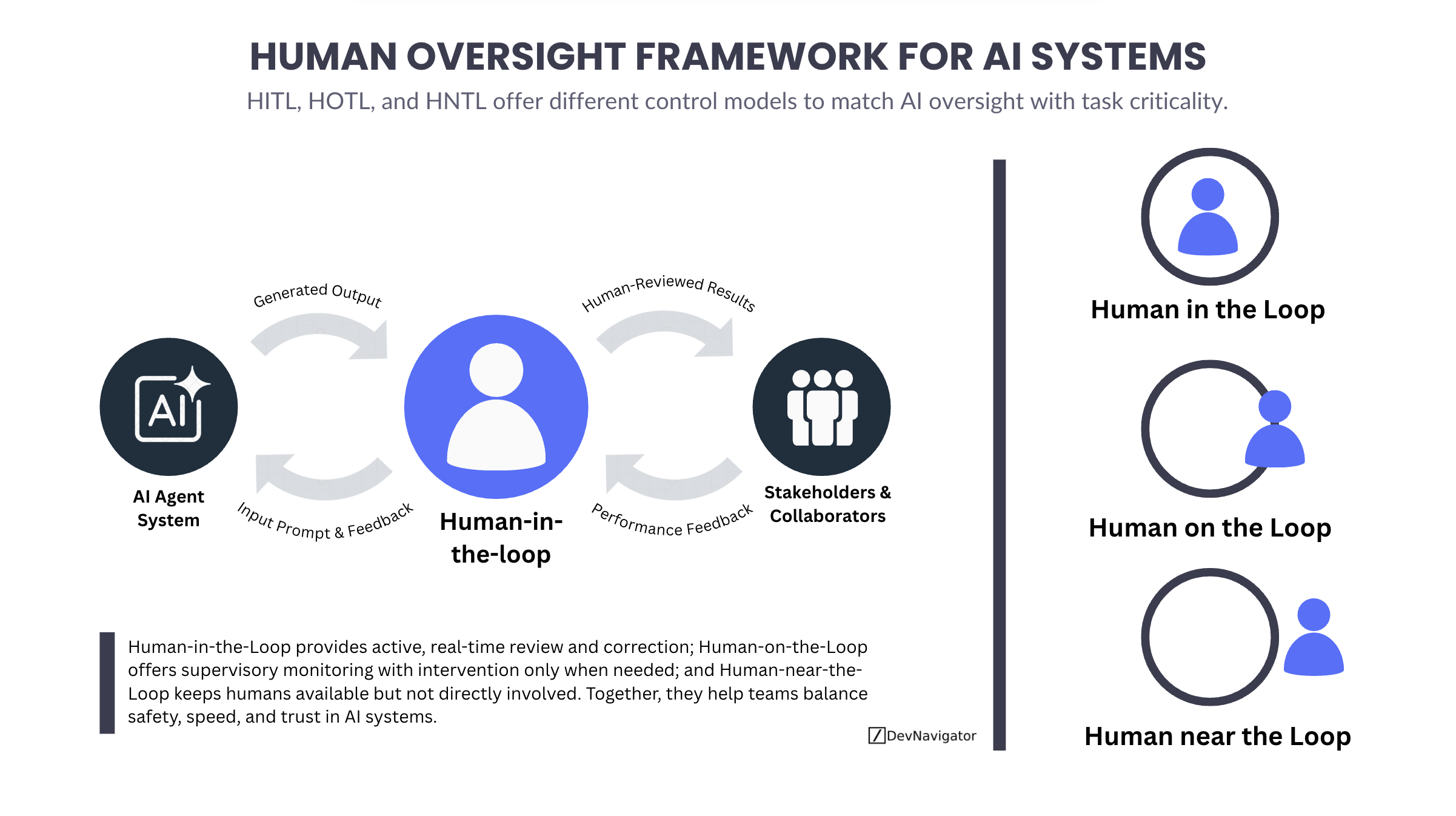
As organizations scale their use of AI systems and autonomous agents, the question is no longer whether humans should remain involved—it’s how. Human oversight is essential for ensuring that AI remains safe, trustworthy, and aligned with business and ethical expectations. The Human-in-the-Loop (HITL), Human-on-the-Loop (HOTL), and Human-near-the-Loop (HNTL) models define different levels of human involvement, allowing teams to calibrate oversight based on task criticality, risk, and required precision. Understanding these distinctions is key to deploying AI systems responsibly and effectively.
Key Takeaways
- HITL ensures real-time intervention and correction, making it ideal for high-risk, high-precision tasks where human judgment is indispensable.
- HOTL shifts humans into a supervisory role, monitoring AI systems and stepping in only when the system deviates or uncertainty rises.
- HNTL supports efficiency at scale, maintaining human availability while allowing AI systems to operate independently for low-risk, repetitive, or high-volume tasks.
Choosing the right oversight model isn’t just a technical decision, it’s a strategic one. Organizations that intentionally design their human + AI workflows are better positioned to maintain safety, accelerate adoption, and build trust with stakeholders. By aligning HITL, HOTL, and HNTL with the level of risk and business impact, teams can unlock AI’s full potential while preserving the guardrails that ensure responsible and reliable outcomes.