

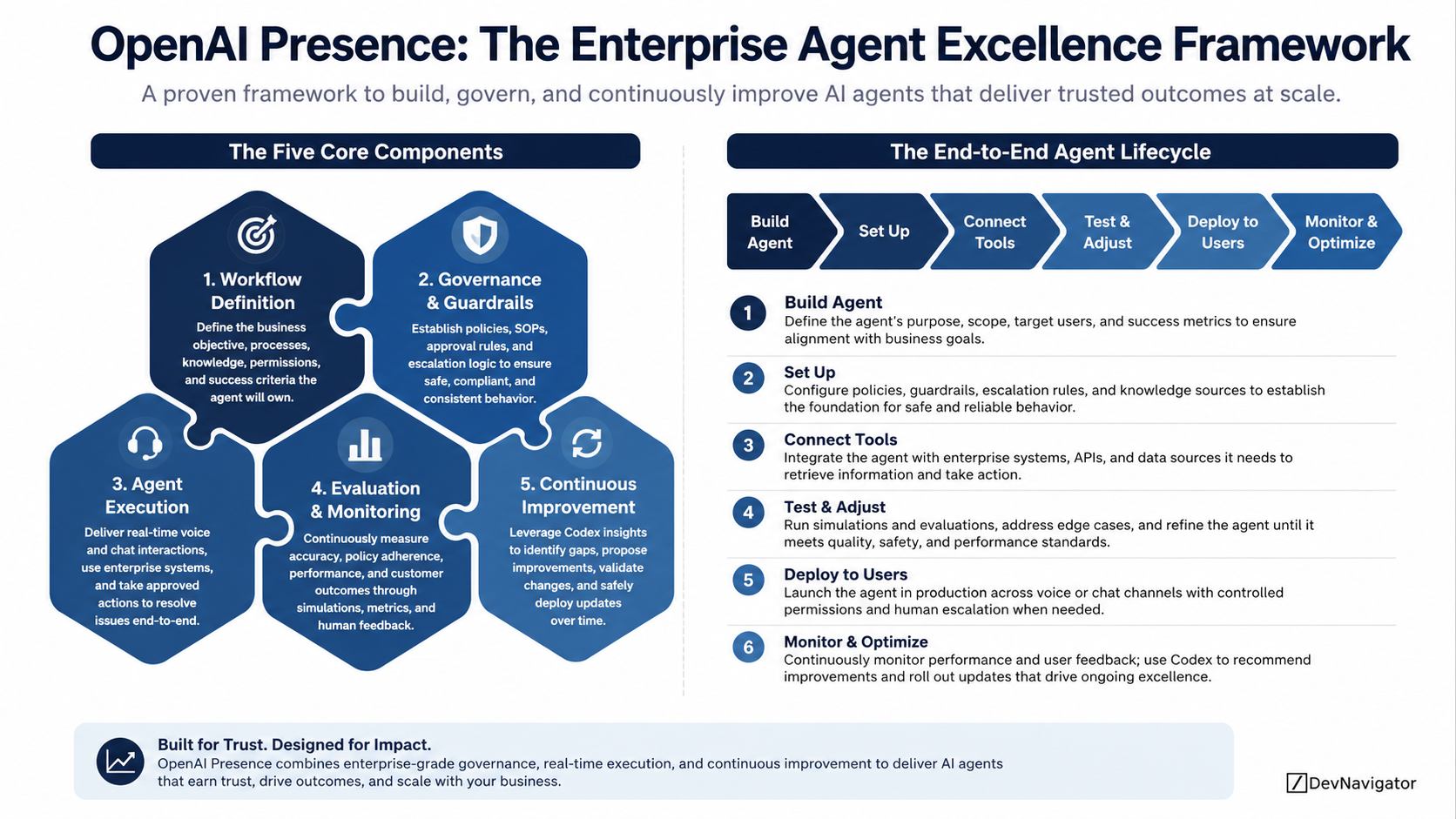
OpenAI Presence represents a shift in how enterprises deploy AI agents. Instead of simply connecting a large language model to company data, Presence provides a complete operating framework for building, governing, evaluating, and continuously improving AI agents in production. The platform combines business workflows, policies, guardrails, enterprise integrations, testing, monitoring, and a continuous improvement loop powered by Codex. The result is an AI system designed to perform real business work while remaining under human oversight. This framework illustrates the five core components that make up OpenAI Presence and the lifecycle organizations follow to move AI agents from concept to production.
Table of Contents
Executive Takeaways
- OpenAI Presence extends beyond a language model by providing the governance, policies, evaluations, and operational controls required for enterprise AI agents.
- Successful enterprise AI depends on a structured lifecycle that includes configuration, testing, deployment, monitoring, and continuous improvement rather than a one-time implementation.
- Continuous evaluation and Codex-powered optimization allow organizations to improve AI performance over time while maintaining human oversight and policy compliance.
Expanded Insights
The Five Core Components of OpenAI Presence
At the center of OpenAI Presence are five capabilities that work together to create a production-ready AI agent.
Everything begins with Workflow Definition. Rather than building a general-purpose assistant, organizations define a specific business responsibility such as customer support, IT service requests, insurance claims, or billing operations. The agent receives only the knowledge, tools, permissions, and objectives required to perform that role.
Once the workflow has been defined, Governance and Guardrails establish how the agent should behave. Companies configure policies, standard operating procedures, approval requirements, escalation rules, and security boundaries that determine when an agent can act independently and when a human must take over. This governance layer is one of the primary differences between enterprise AI and consumer chatbots.
The third component is Agent Execution, where the AI interacts with users through voice or chat while accessing enterprise systems to retrieve information and perform approved actions. Instead of simply answering questions, the agent becomes capable of completing real business processes within predefined limits.
To ensure consistent performance, Evaluation and Monitoring continuously measure quality before and after deployment. Simulations, production metrics, policy adherence, customer feedback, and human review provide visibility into how well the agent performs and where improvements are needed.
Finally, Continuous Improvement closes the loop. Production data is analyzed, Codex recommends changes, teams validate those updates through testing, and approved improvements are safely rolled into production. This creates an AI system that evolves alongside changing business processes and customer expectations.
From Prototype to Production
The lifecycle shown in this framework highlights why deploying enterprise AI is much more than building a chatbot.
The process starts by defining the agent’s purpose and configuring its policies, permissions, and knowledge sources. Organizations then connect the agent to enterprise systems and APIs so it can retrieve information and complete approved actions.
Before users ever interact with the agent, simulations and evaluations test common scenarios, edge cases, and policy compliance. This validation stage helps organizations identify weaknesses before deployment instead of after customers discover them.
Once testing is complete, the agent is deployed into production across voice or chat channels with controlled permissions and clearly defined escalation paths. Human experts remain available whenever the interaction exceeds the agent’s authority or confidence.
After launch, monitoring becomes an ongoing activity rather than a final checkpoint. Performance metrics, user feedback, and production sessions provide the evidence needed to improve future versions while maintaining operational stability.
Why OpenAI Presence Matters
Many organizations have demonstrated that AI can answer questions. Far fewer have proven that AI can reliably execute business processes under enterprise governance.
That distinction is where OpenAI Presence fits. It combines large language models with operational controls, evaluation frameworks, human oversight, and continuous optimization into a single deployment model. Rather than treating AI agents as isolated applications, it treats them as managed enterprise systems that require governance throughout their lifecycle.
As enterprise adoption continues to accelerate, platforms like OpenAI Presence illustrate that successful AI deployments depend as much on policy, evaluation, and operational discipline as they do on model intelligence. Organizations that combine these elements will be better positioned to deploy trusted AI agents that improve over time while remaining aligned with business objectives.