

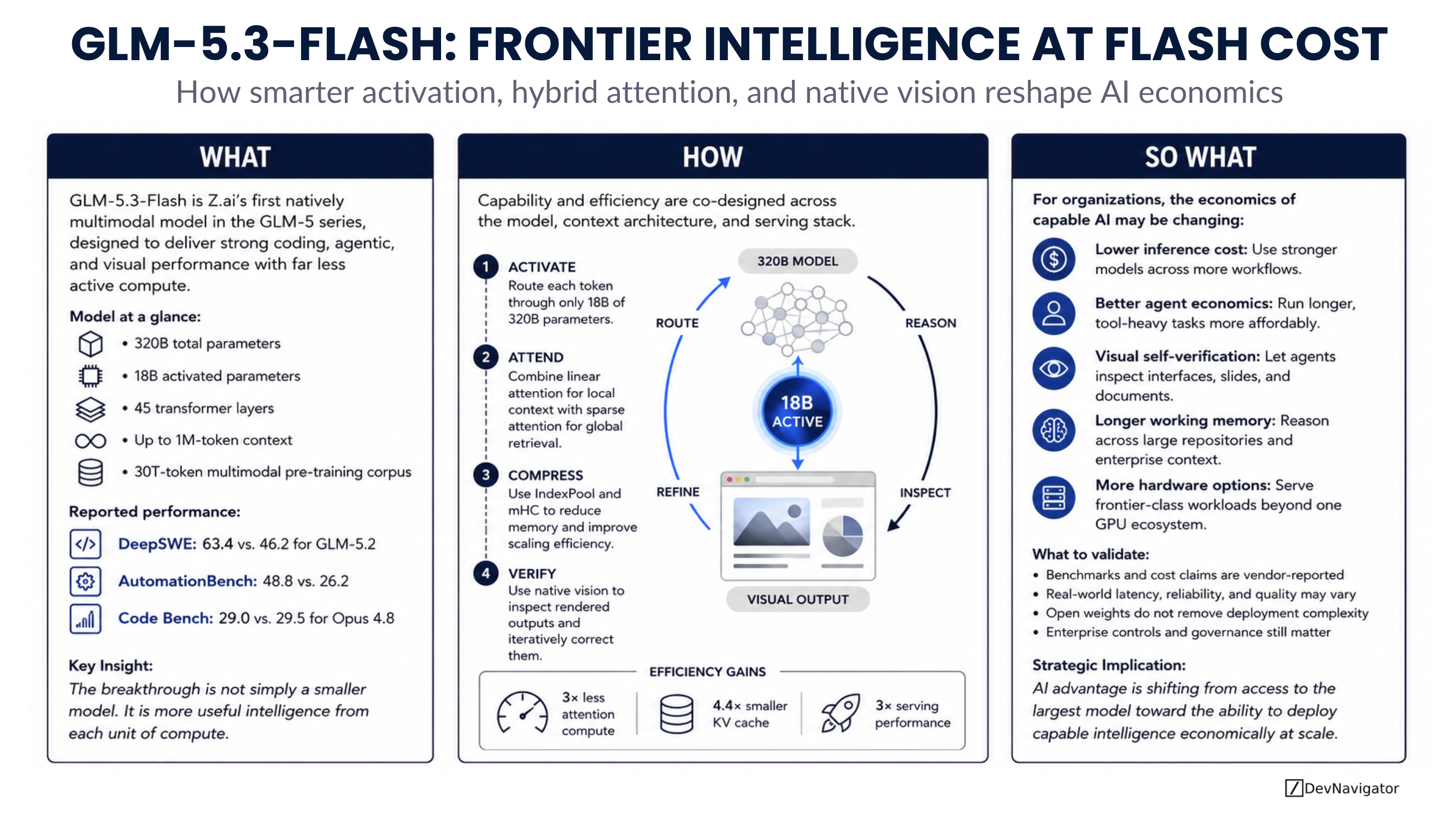
GLM-5.3-Flash is not important because it is another large AI model. It matters because it demonstrates how architecture, multimodal training, and infrastructure can work together to deliver capable AI at a much lower operating cost. The result points toward an AI market where efficiency matters as much as raw intelligence.
Table of Contents
Executive Takeaways
- GLM-5.3-Flash activates only 18 billion of its 320 billion parameters, allowing the model to preserve broad capabilities without using its full computational footprint for every token.
- Hybrid attention and memory optimization reduce long-context costs, with Z.ai reporting three times less attention compute and a 4.4-times smaller KV cache than GLM-5.3.
- The strategic shift is from model access to model economics. Organizations will increasingly compete on how effectively they deploy capable AI across real workflows.
Strategic Insights
What Is GLM-5.3-Flash?
GLM-5.3-Flash is Z.ai’s first natively multimodal model in the GLM-5 series. It accepts text and image inputs, supports a context window of up to one million tokens, and is designed for coding, agentic automation, visual reasoning, and professional knowledge work.
The model contains 320 billion total parameters but activates only 18 billion during inference. This selective activation allows GLM-5.3-Flash to draw from a large model while reducing the amount of computation required for each request.
Z.ai reports that GLM-5.3-Flash outperforms GLM-5.2 across several coding and agentic benchmarks. Its reported DeepSWE score increased from 46.2 to 63.4, while its AutomationBench score increased from 26.2 to 48.8. These results remain vendor-reported, but Artificial Analysis separately gives the model an Intelligence Index score of 57 and lists highly competitive API pricing.
How Does It Use Less Compute?
The efficiency of GLM-5.3-Flash comes from more than parameter activation. Z.ai redesigned the architecture around lower-cost inference and long-context processing.
The model combines linear attention for local relationships with sparse attention for retrieving relevant information from the wider context. This avoids applying the same expensive attention pattern across every token. IndexPool further reduces memory requirements by compressing groups of indexer key vectors.
GLM-5.3-Flash also uses 45 transformer layers, compared with 92 in the earlier GLM-4.5 architecture. Manifold-Constrained Hyper-Connections, or mHC, are used to improve scaling efficiency and training stability.
Together, these changes produce what Z.ai describes as three times less attention compute and a 4.4-times smaller KV cache compared with the full GLM-5.3 model. The company also reports a threefold improvement in serving performance after optimizing its inference stack.
Why Native Vision Matters
The multimodal capability is not limited to interpreting an uploaded image. GLM-5.3-Flash is designed to place visual inspection directly inside an agent’s working loop.
An agent can generate an interface, presentation, dashboard, or application, inspect the rendered result, identify visual defects, and revise the underlying artifact. This creates a loop of generation, observation, and correction.
That matters because many failures cannot be detected by reading code alone. A page may technically function while still containing broken layouts, unreadable text, or confusing interactions. Native vision allows AI agents to evaluate more of the actual user experience.
What Does This Mean for Organizations?
The immediate opportunity is better agent economics. Coding agents and enterprise agents often consume large amounts of context, make repeated tool calls, and iterate several times before completing a task. A less expensive model can make these longer workflows practical across a much larger user base.
The one-million-token context window may also help agents work across code repositories, documents, policies, and connected enterprise information. However, context size does not automatically create context quality. Organizations still need governed data products and connected enterprise context to help models interpret information correctly.
Open weights provide additional deployment options, but GLM-5.3-Flash is not a lightweight local model. Hosting a 320-billion-parameter model still requires substantial infrastructure, optimization, and technical expertise. Real-world latency, reliability, security, and total cost should be tested against the intended workload.
The broader signal is clear: the next stage of AI competition will not be defined only by who builds the largest model. It will be defined by who delivers the most useful intelligence per dollar, per token, and per watt.