

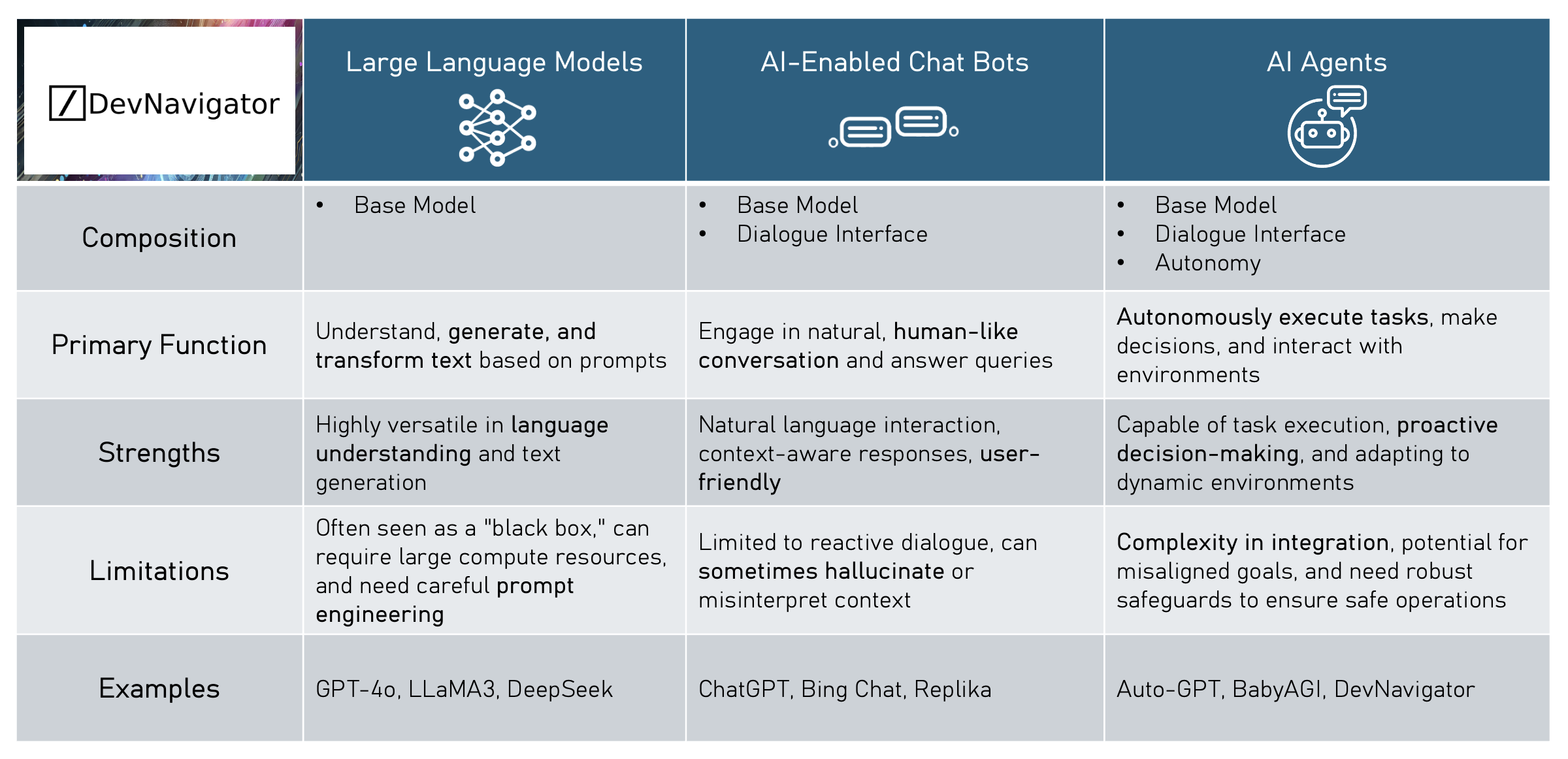
AI Agents are quickly becoming one of the most misunderstood terms in modern technology conversations. The phrase is often used interchangeably with chatbots or large language models, even though the differences between them are substantial and consequential. This article clarifies the evolution from large language models to AI-enabled chatbots and finally to AI Agents. By breaking down composition, function, strengths, and limitations, this piece explains why Agents represent a meaningful shift in how organizations design, deploy, and govern intelligent systems. Understanding this progression helps leaders invest wisely, manage risk, and unlock real business value rather than chasing hype.
Table of Contents
Executive Takeaways
- AI Agents are not just better chatbots; they introduce autonomy, task execution, and environmental interaction on top of language intelligence
- Large language models provide intelligence, chatbots provide interaction, and AI Agents provide action
- Organizations that treat AI Agents as strategy, not tooling, are better positioned to scale value safely and responsibly
Expanded Insights
Large Language Models: The Foundation of Intelligence
Large language models sit at the base of the modern AI stack. Their core function is to understand, generate, and transform text based on prompts. These models excel at language understanding, summarization, reasoning, and content creation. They are highly versatile and form the intelligence layer that everything else builds on.
Despite their power, large language models are passive by design. They do not act unless prompted, and they do not interact with systems or environments on their own. They also require careful prompt engineering and significant compute resources. This is why large language models alone rarely deliver business outcomes without additional layers around them. AI Agents depend on this foundational intelligence but extend far beyond it.
AI-Enabled Chatbots: Interaction Without Autonomy
AI-enabled chatbots add a dialogue interface on top of large language models. This makes AI accessible to users through natural, conversational interaction. Chatbots can answer questions, guide users, and provide context-aware responses in a user-friendly way.
However, chatbots remain reactive. They respond to inputs but do not initiate actions or make decisions independently. While they can sometimes misinterpret context or hallucinate, their primary limitation is structural. They are designed for conversation, not execution. This distinction is critical when evaluating Agents, which move beyond interaction into action.
AI Agents: Where Intelligence Becomes Action
AI Agents represent a step change. They combine a base model, a dialogue interface, and autonomy. This autonomy allows Agents to execute tasks, make decisions, interact with systems, and adapt to changing environments.
Unlike chatbots, AI Agents can plan, observe outcomes, adjust behavior, and act again. This makes them suitable for complex workflows such as data analysis, monitoring systems, orchestrating tools, and supporting operational decisions. Agents can proactively identify next steps instead of waiting for a prompt.
This power comes with tradeoffs. Agents introduce integration complexity, require careful alignment with goals, and demand strong safeguards. Without governance, AI Agents can drift, act on incomplete information, or create unintended consequences. This is why Agents should be treated as operational systems, not novelty features.
Choosing the Right Capability for the Job
Not every problem requires AI Agents. Many use cases are well served by large language models or chatbots alone. The mistake organizations make is skipping levels, expecting autonomy when they have only deployed interaction, or expecting business value when they have only deployed intelligence.
AI Agents are most effective when the problem requires action, coordination, or continuous decision-making. When implemented thoughtfully, Agents can accelerate work, reduce friction, and improve consistency. When implemented carelessly, they amplify confusion faster than any system before them.
Why AI Agents Change the Strategic Conversation
AI Agents shift AI discussions from experimentation to accountability. Once systems can act, the questions change. Leaders must consider ownership, risk, auditability, and outcomes. This is where Agents force maturity in governance, architecture, and operating models.
The real value of AI Agents is not technical novelty. It is their ability to connect intelligence to execution. Organizations that understand this distinction are better equipped to move from pilots to production without losing trust or control.
AI Agents are not the future in theory. They are already here in practice. The difference between success and failure lies in knowing what they are, what they are not, and when to deploy them intentionally.