

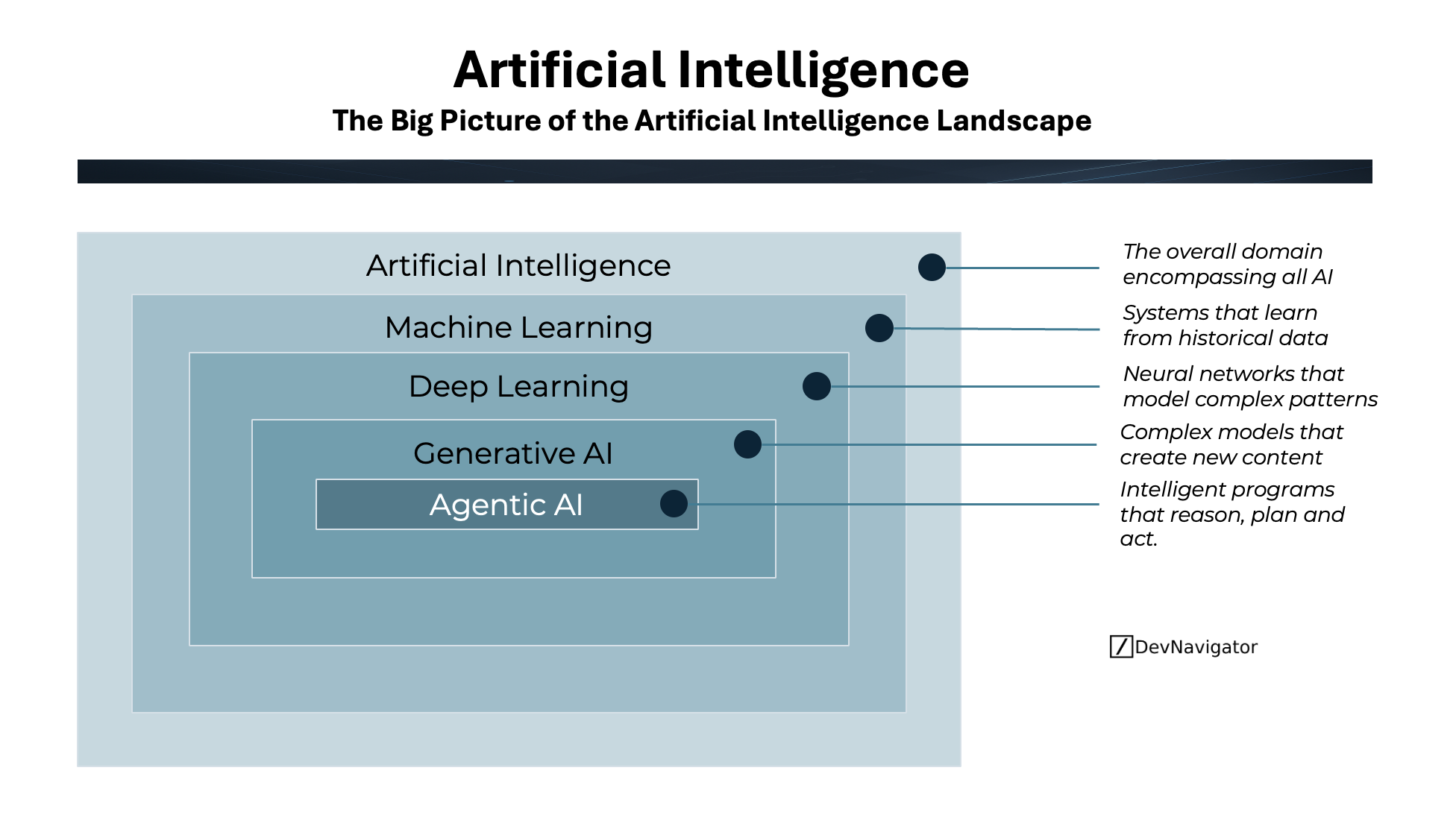
The Artificial Intelligence Landscape has expanded rapidly, leaving many leaders and practitioners struggling to distinguish buzzwords from real capability. Terms like machine learning, deep learning, generative AI, and agentic AI are often used interchangeably, yet each represents a distinct layer with different strengths, risks, and use cases. Understanding the Artificial Intelligence Landscape is no longer optional. It is foundational for making sound technology decisions, prioritizing investments, and setting realistic expectations. This article breaks down the Artificial Intelligence Landscape into five clear layers and explains how they relate, where confusion arises, and why clarity matters more than ever.
Table of Contents
Executive Takeaways
- The Artificial Intelligence Landscape is hierarchical, not fragmented, with each layer building on the one beneath it.
- Confusing layers like generative AI and agentic AI leads to unrealistic expectations and failed implementations.
- Strategic value comes from aligning business problems to the correct layer of the Artificial Intelligence Landscape.
Expanded Insights
Artificial Intelligence as the Umbrella Domain
At the highest level, artificial intelligence refers to systems designed to perform tasks that normally require human intelligence. This includes reasoning, perception, decision making, and problem solving. The Artificial Intelligence Landscape begins here as a broad domain, not a single technology. Rule based systems, expert systems, optimization algorithms, and modern learning based approaches all fall under this umbrella. This distinction matters because not all AI involves learning, neural networks, or large datasets. Many production systems still rely on classical AI techniques that are deterministic, interpretable, and highly reliable.
Machine Learning as the Engine of Adaptation
Machine learning sits one level deeper in the Artificial Intelligence Landscape. It represents systems that learn patterns from historical data rather than relying solely on explicit rules. These models improve performance over time as more data becomes available. Common examples include regression models, decision trees, and gradient boosting algorithms. Machine learning excels at prediction, classification, and anomaly detection. Importantly, machine learning does not require deep neural networks. Many of the most impactful enterprise AI systems today rely on relatively simple models that are easier to validate, govern, and deploy.
Deep Learning and Representation Learning
Deep learning is a specialized subset of machine learning that relies on multi layer neural networks. Within the Artificial Intelligence Landscape, deep learning enables models to learn complex representations directly from raw data such as images, audio, text, and sensor signals. This capability unlocked breakthroughs in computer vision, speech recognition, and natural language processing. However, deep learning comes with tradeoffs. It requires large datasets, significant compute resources, and introduces challenges around interpretability and operational risk. Understanding where deep learning fits in the Artificial Intelligence Landscape helps organizations avoid overengineering solutions where simpler approaches would suffice.
Generative AI and Content Creation
Generative AI represents a further specialization within deep learning. These models do not just analyze or classify data. They create new content such as text, images, code, audio, and video. Large language models, diffusion models, and multimodal systems all fall into this layer of the Artificial Intelligence Landscape. Generative AI has transformed knowledge work, enabling rapid drafting, summarization, and ideation. At the same time, it introduces new concerns around hallucinations, intellectual property, and reliability. Treating generative AI as a universal solution rather than a specific capability is one of the most common strategic mistakes.
Agentic AI and Autonomous Action
Agentic AI sits at the innermost layer of the Artificial Intelligence Landscape. These systems combine generative models with planning, memory, tool use, and decision logic to take action toward goals. Unlike standalone generative AI, agentic systems can reason across steps, invoke external systems, and adapt based on outcomes. This makes them powerful but also risky if poorly governed. Agentic AI is best suited for controlled workflows, human in the loop systems, and environments where autonomy is explicitly designed and monitored. It is not simply generative AI with a new name. It represents a shift from content generation to goal directed behavior.
Why the Artificial Intelligence Landscape Matters
Clarity across the Artificial Intelligence Landscape prevents misalignment between strategy and execution. Leaders who understand these layers can ask better questions, fund the right initiatives, and set achievable expectations. Teams that navigate the Artificial Intelligence Landscape effectively are more likely to deliver real value rather than prototypes that never scale. As AI continues to evolve, the organizations that win will not be the ones chasing every trend, but those grounded in a clear understanding of how each layer fits into the bigger picture.