

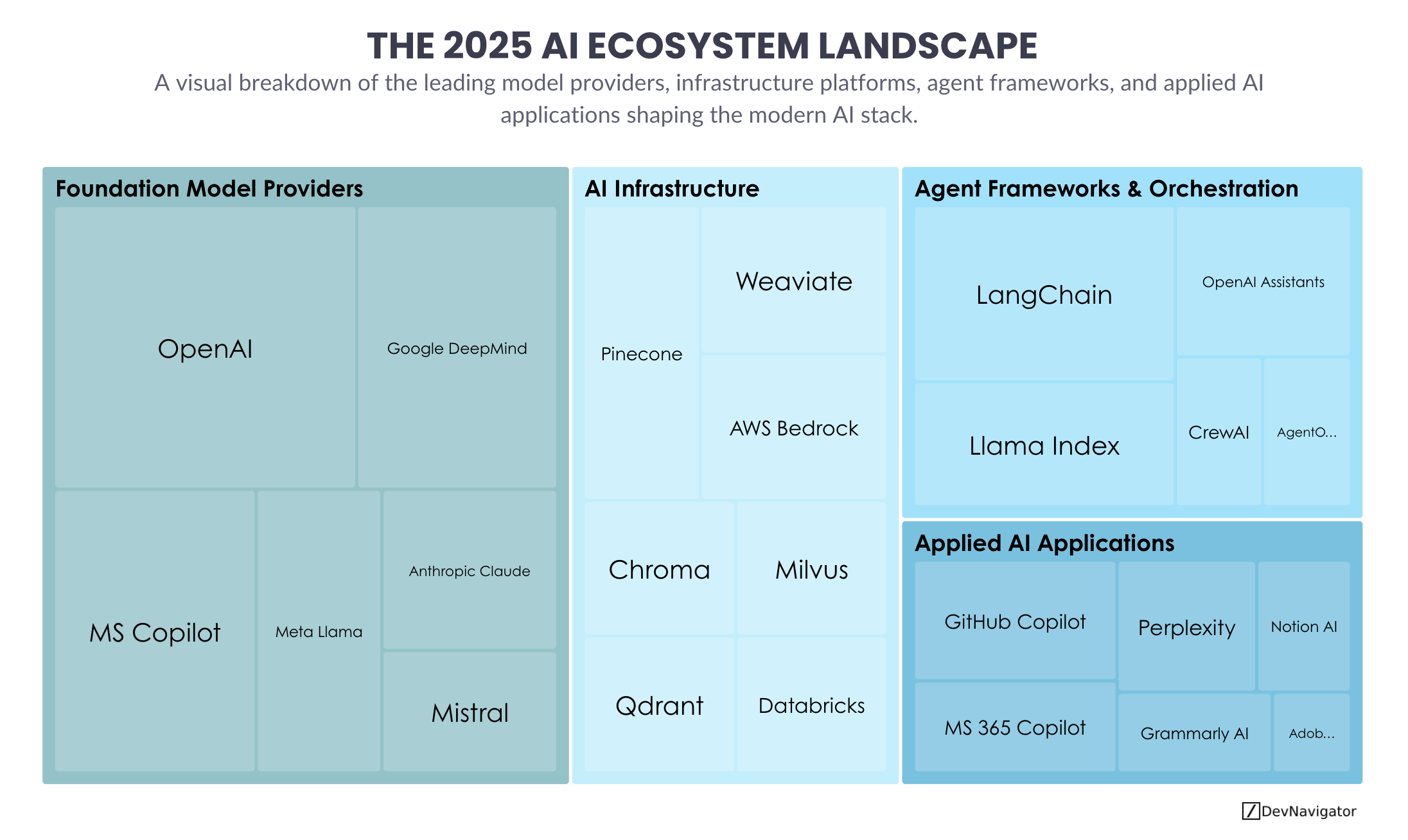
The AI ecosystem in 2025 has evolved into a layered, highly interconnected stack, specifically one where foundation models, infrastructure platforms, agent frameworks, and applied AI products each play a distinct role in delivering intelligent systems. This infographic breaks down the modern AI landscape into four major categories, showing how the industry’s most influential players fit together as organizations race to adopt AI at scale. From foundational model providers like OpenAI and Google DeepMind, to orchestration frameworks such as LangChain, to the everyday AI tools millions rely on, the ecosystem is more dynamic and competitive than ever.
Three important items to note about this landscape:
- Foundation model providers continue to dominate the stack, with OpenAI, Google DeepMind, Anthropic, Meta, and Mistral supplying the core intelligence that powers nearly every major AI application.
- Infrastructure platforms are becoming critical differentiators, as vector databases, embedding stores, and cloud-hosted model hubs (like Pinecone, Weaviate, AWS Bedrock, and Qdrant) enable scalable retrieval, fine-tuning, and enterprise deployment.
- Agent frameworks are ushering in the next wave of automation, with LangChain, LlamaIndex, OpenAI Assistants, and CrewAI enabling multi-step reasoning, tool use, and autonomous workflows across industries.
As organizations adopt AI more deeply into their operations, understanding the ecosystem becomes essential for making strategic technology choices. The 2025 landscape shows an industry moving toward modularity, interoperability, and agentic automation, where companies combine foundation models, orchestration layers, and domain-specific applications to build powerful, end-to-end AI systems. This is the modern AI stack, and it’s only accelerating from here.