

AI Agent Communication Protocols are quickly becoming the backbone of modern agentic systems. As organizations move beyond single-model experiments toward networks of autonomous agents, the ability for those agents to share context, coordinate actions, and operate safely across tools has become a defining challenge. This article breaks down how AI Agent Communication Protocols work in practice, focusing on three foundational approaches: Model Context Protocol, Agent-to-Agent communication, and Agent Communication Protocol registries. Together, they form the technical glue that allows intelligent agents to collaborate at scale without collapsing into chaos.
Table of Contents
Executive Takeaways
- AI Agent Communication Protocols define how agents exchange context, invoke tools, and coordinate decisions in multi-agent systems.
- Different protocols solve different layers of the problem, from tool access to peer collaboration to large-scale orchestration.
- Choosing the right mix of AI Agent Communication Protocols is critical for building reliable, secure, and scalable agent ecosystems.
Expanded Insights
Why AI Agent Communication Protocols Matter
As AI systems evolve, agents are no longer isolated reasoning engines responding to a single prompt. Modern systems increasingly involve multiple agents, each with specialized roles, operating across databases, APIs, and external tools. Without standardized AI Agent Communication Protocols, these systems become brittle, opaque, and difficult to govern.
Communication protocols act as contracts. They define what context is shared, how actions are requested, and how trust is established between agents and tools. This is what enables collaboration without requiring every agent to know the internal workings of every other component.
Model Context Protocol: Structured Access to Tools
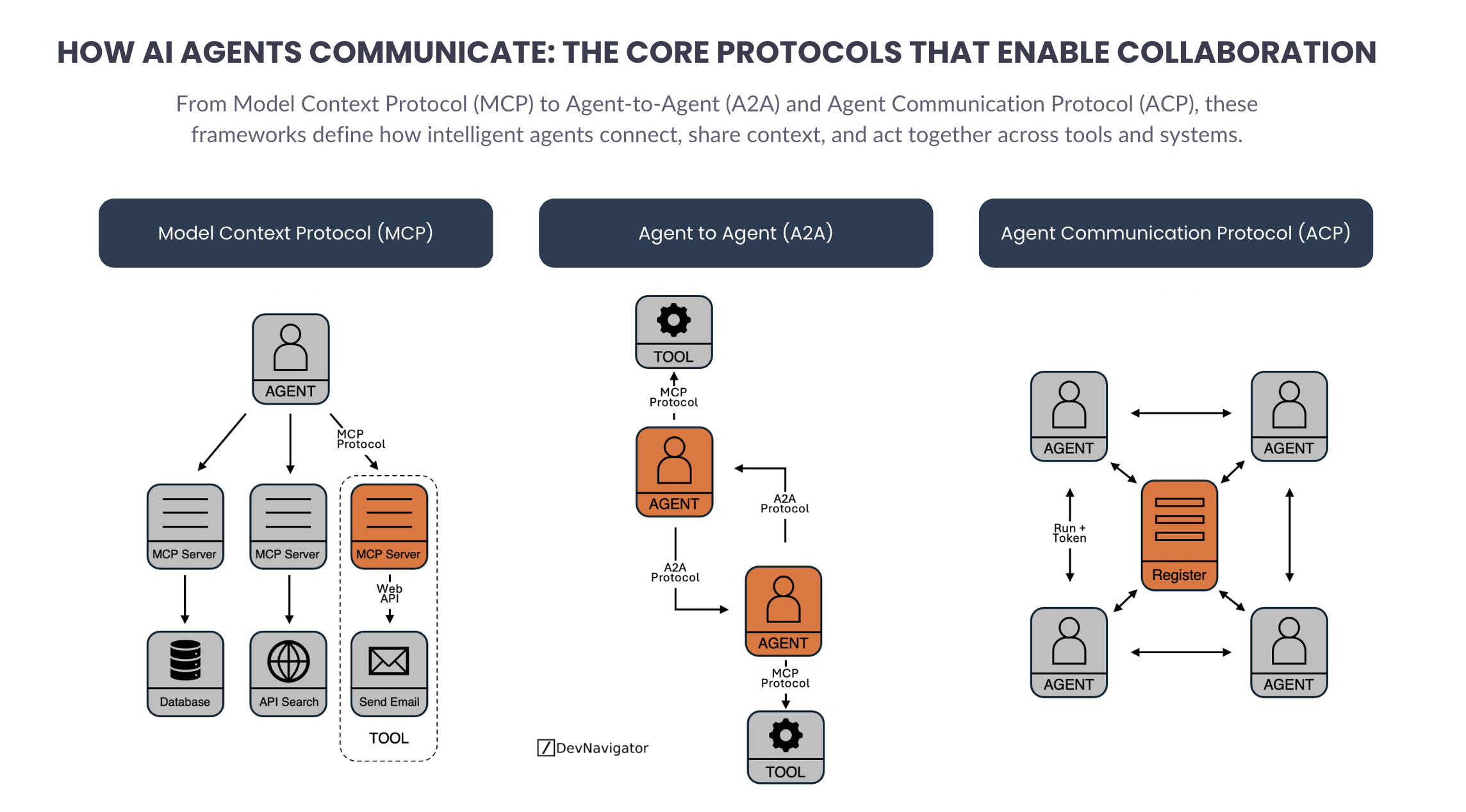
Model Context Protocol, often abbreviated as MCP, focuses on the relationship between an agent and the tools it can use. Instead of hard-coding tool logic into the model, MCP introduces a structured server layer that exposes capabilities such as databases, APIs, or messaging systems in a consistent way.
In this setup, the agent requests context or actions through the protocol, and the MCP server handles execution. This separation improves security, observability, and maintainability. MCP is one of the most practical AI Agent Communication Protocols because it cleanly decouples reasoning from execution, allowing tools to evolve independently of models.
Agent-to-Agent Communication: Coordinated Intelligence
Agent-to-Agent communication, commonly referred to as A2A, addresses a different problem. Rather than focusing on tools, it defines how agents talk directly to each other. This is essential when tasks require delegation, negotiation, or shared situational awareness.
With A2A, one agent can pass goals, intermediate results, or constraints to another agent. This enables patterns such as planner and executor roles, peer review agents, or domain-specific specialists. Among AI Agent Communication Protocols, A2A is the key enabler of collaborative reasoning, allowing systems to decompose complex problems into coordinated actions.
Agent Communication Protocol Registries: Scaling the Network
As the number of agents grows, direct peer connections quickly become unmanageable. This is where Agent Communication Protocol registries come into play. Instead of agents discovering each other ad hoc, a central registry manages identity, capabilities, and authorization.
Agents register themselves, obtain tokens, and communicate through defined channels. This pattern supports scalability, governance, and fault isolation. In large enterprises, registries make AI Agent Communication Protocols auditable and enforceable, which is critical for compliance and operational reliability.
How These Protocols Work Together
The real power emerges when these approaches are combined. An agent might use Model Context Protocol to retrieve data from a system of record, communicate insights to another agent via Agent-to-Agent messaging, and rely on a registry-backed Agent Communication Protocol to ensure secure routing and access control.
Rather than competing standards, these AI Agent Communication Protocols form complementary layers. One governs tool access, another governs collaboration, and the third governs coordination at scale. Together, they transform isolated agents into coherent systems.
Designing with AI Agent Communication Protocols in Mind
When designing agentic systems, protocol choices should be intentional. MCP is ideal when tool reliability and separation of concerns matter most. A2A becomes essential as soon as reasoning spans multiple agents. Registries are unavoidable once systems move beyond experimentation into production.
Organizations that treat AI Agent Communication Protocols as first-class architecture components gain flexibility and resilience. Those that ignore them often end up with tightly coupled systems that are difficult to debug, secure, or scale.