

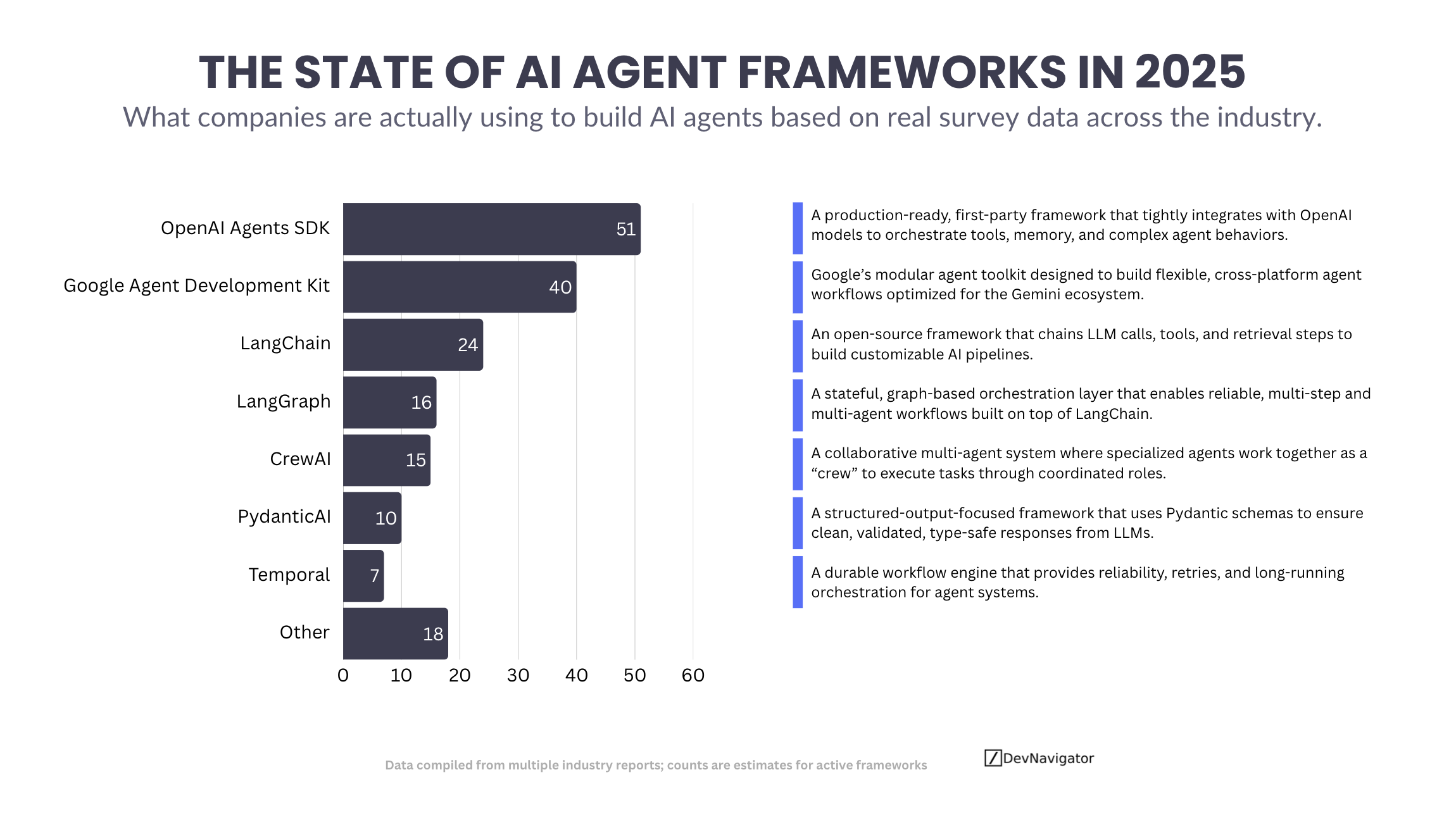
AI Agent Frameworks have moved from experimentation to execution. As organizations push beyond pilots and proofs of concept, the question is no longer whether to use AI agents, but which AI Agent Frameworks can reliably operate at production scale. Based on recent industry survey data, adoption is consolidating around a small set of platforms that prioritize orchestration reliability, deep model integration, and operational stability. This article breaks down the current state of AI Agent Frameworks in 2025, explains why OpenAI and Google are leading adoption, and clarifies where open-source and workflow-oriented frameworks continue to play critical roles.
Table of Contents
Executive Takeaways
- AI Agent Frameworks are consolidating fast, with enterprises favoring platforms that emphasize production reliability, governance, and deep ecosystem integration over experimentation.
- First-party frameworks from OpenAI and Google now dominate production adoption, signaling a shift toward vertically integrated agent stacks.
- Specialized frameworks remain essential, particularly for stateful orchestration, structured outputs, and long-running workflows that enterprise environments demand.
Expanded Insights
The Maturation of AI Agent Frameworks
AI Agent Frameworks are no longer novelty tooling. In 2025, they are becoming core infrastructure for automation, analytics, decision support, and operational workflows. Early experimentation favored flexibility and rapid prototyping, but production deployment has reshaped priorities. Organizations now care most about reliability, orchestration guarantees, integration depth, and long-term maintainability. This shift explains why AI Agent Frameworks with strong platform backing are pulling ahead.
OpenAI Agents SDK: The Production Benchmark
Among AI Agent Frameworks, OpenAI Agents SDK currently leads adoption. Its strength lies in being a first-party framework that tightly integrates models, tools, memory, and orchestration under a single platform. For teams already standardized on OpenAI, this reduces architectural friction and accelerates deployment.
The tradeoff is flexibility. While powerful, this approach favors OpenAI’s ecosystem and is less suited for organizations pursuing multi-model or hybrid-cloud strategies. Even so, for teams prioritizing speed to production, OpenAI Agents SDK has become the default choice within the broader AI Agent Frameworks landscape.
Google Agent Development Kit: Modular and Cloud-Native
Google’s Agent Development Kit follows closely, reflecting strong adoption in Google Cloud environments. Among AI Agent Frameworks, ADK stands out for its modularity and cross-service interoperability. It aligns naturally with Gemini models and Google’s broader cloud tooling, making it attractive for enterprises already invested in that ecosystem.
Adoption momentum trails OpenAI slightly, but the architectural foundation is solid. As Gemini adoption increases, ADK is positioned to remain a central player in AI Agent Frameworks focused on enterprise scale and cloud-native design.
LangChain and LangGraph: Flexibility Meets Structure
LangChain remains one of the most recognizable AI Agent Frameworks due to its vast ecosystem and flexibility. It excels at rapid experimentation and custom workflows, particularly in retrieval-augmented systems. However, as systems grow more complex, orchestration reliability can become a challenge.
LangGraph addresses this gap by introducing stateful, graph-based orchestration. Within the ecosystem of AI Agent Frameworks, LangGraph represents a move toward determinism and production readiness, especially for multi-step or branching workflows. The learning curve is steeper, but the payoff is greater control.
CrewAI and PydanticAI: Purpose-Built Specialization
CrewAI has carved out a niche within AI Agent Frameworks for role-based multi-agent collaboration. Its strength is conceptual clarity and ease of setup, making it popular for task-oriented automation and demonstrations. However, it is not designed for long-running, failure-resistant enterprise workloads.
PydanticAI approaches the problem differently. Rather than full orchestration, it focuses on structured, validated outputs. In production environments where correctness matters more than autonomy, PydanticAI complements other AI Agent Frameworks by enforcing schema reliability.
Temporal: The Reliability Backbone
Temporal is not an AI Agent Framework in the traditional sense, but its role is increasingly critical. As AI agents move into mission-critical workflows, durable execution, retries, and long-running state management become non-negotiable. Temporal provides these guarantees and is often layered beneath AI Agent Frameworks to harden them for enterprise use.
The tradeoff is operational complexity, but for regulated or high-availability environments, this overhead is often justified.
What the Data Signals About the Future
The current adoption data reveals a clear pattern. AI Agent Frameworks are consolidating around platforms that reduce risk, simplify governance, and integrate deeply with existing infrastructure. Flexibility remains valuable, but stability now wins. As the ecosystem matures, the most successful teams will combine dominant AI Agent Frameworks with specialized tooling rather than betting on a single solution.