

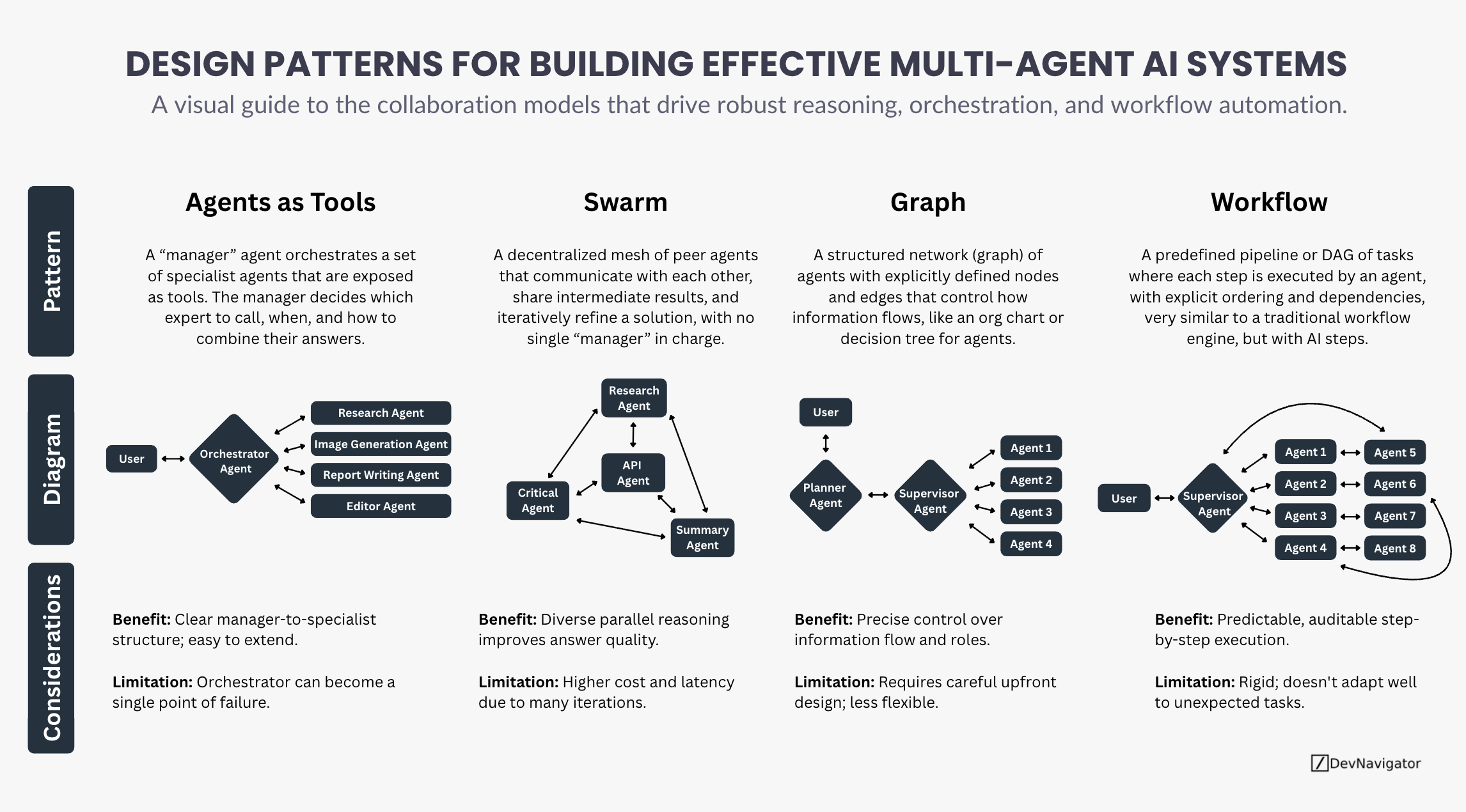
Multi-agent AI systems are rapidly moving from experimental prototypes into real business workflows. As organizations deploy multiple agents to reason, plan, and execute tasks autonomously, architecture becomes the deciding factor between systems that scale and those that collapse under complexity. Multi-Agent AI Design Patterns provide the structural foundation for how agents collaborate, exchange information, and deliver value. This article explores four essential patterns: Agents as Tools, Swarm, Graph, and Workflow, explaining where each excels, where it breaks down, and how advanced teams combine them to build resilient, production-grade AI systems.
Table of Contents
Executive Takeaways
- Multi-Agent AI Design Patterns determine system success. The way agents collaborate directly impacts reliability, cost, governance, and performance.
- Each pattern optimizes for a different outcome. Specialization, parallel reasoning, controlled decision flow, and predictable execution cannot all be maximized at once.
- Hybrid architectures outperform single-pattern systems. The strongest multi-agent solutions intentionally combine patterns to match real organizational needs.
Expanded Insights
Why Multi-Agent Architecture Is a Strategic Decision
As AI systems evolve beyond single prompts and single models, architecture becomes strategy. Multi-Agent AI Design Patterns define how intelligence is distributed across agents, how decisions are made, and how failure is contained. These choices shape whether an AI system behaves like a disciplined operations team, a creative brainstorming group, or an automated assembly line.
The four core patterns discussed here form the backbone of nearly all production multi-agent systems in use today. While they appear distinct, they often coexist within the same application.
Agents as Tools: Structured Specialization
The Agents as Tools pattern mirrors a classic manager and specialist model. A central orchestrator determines which agent to call, when to call it, and how to combine outputs into a final result. This approach shines when tasks require clear expertise boundaries, such as research, summarization, image generation, or report writing.
Within Multi-Agent AI Design Patterns, this model is one of the easiest to reason about and extend. However, it introduces a single point of failure. If the orchestrator logic is flawed or overwhelmed, the entire system degrades. This pattern works best when predictability matters more than adaptability.
Swarm: Emergent Intelligence Through Parallel Reasoning
Swarm architectures remove the manager entirely. Agents operate as peers, exchanging intermediate outputs and refining ideas collectively. This pattern excels at exploration, hypothesis generation, and creative problem solving.
In the context of Multi-Agent AI Design Patterns, Swarms offer unmatched diversity of thought. The tradeoff is cost and latency. Multiple iterations across agents can quickly become expensive, and convergence is not guaranteed. Swarms are most effective when insight quality matters more than speed or strict control.
Graph: Governed Decision Pathways
Graph-based systems introduce explicit structure. Agents are nodes, connections are edges, and information flows along predefined paths. This approach enables precise control over who sees what and when decisions are made.
Among Multi-Agent AI Design Patterns, Graph architectures are ideal for regulated environments where auditability, traceability, and role clarity are essential. The downside is rigidity. Designing the graph requires significant upfront thought, and adapting to new scenarios can be slow without redesigning the structure.
Workflow: Predictability and Auditability at Scale
Workflow patterns resemble traditional automation pipelines. Each agent performs a defined step in sequence, often with explicit dependencies and checkpoints. This model is highly reliable and easy to audit.
Within Multi-Agent AI Design Patterns, Workflows are the preferred choice for operational processes such as document processing, data validation, and compliance reporting. Their limitation is flexibility. When unexpected inputs or edge cases arise, workflows struggle unless exception handling is carefully designed.
Why Hybrid Systems Win
The most effective real-world systems do not choose one pattern. They combine them. A workflow may govern high-level stages, a graph may enforce oversight, agents may act as tools within each stage, and swarm reasoning may be invoked selectively for complex decisions.
Modern orchestration frameworks and cost-efficient models make this blending practical. Mastering Multi-Agent AI Design Patterns is not about memorizing diagrams. It is about designing systems that reflect how real organizations think, decide, and operate.
When architecture aligns with intent, multi-agent AI stops being a novelty and becomes a durable competitive advantage.