

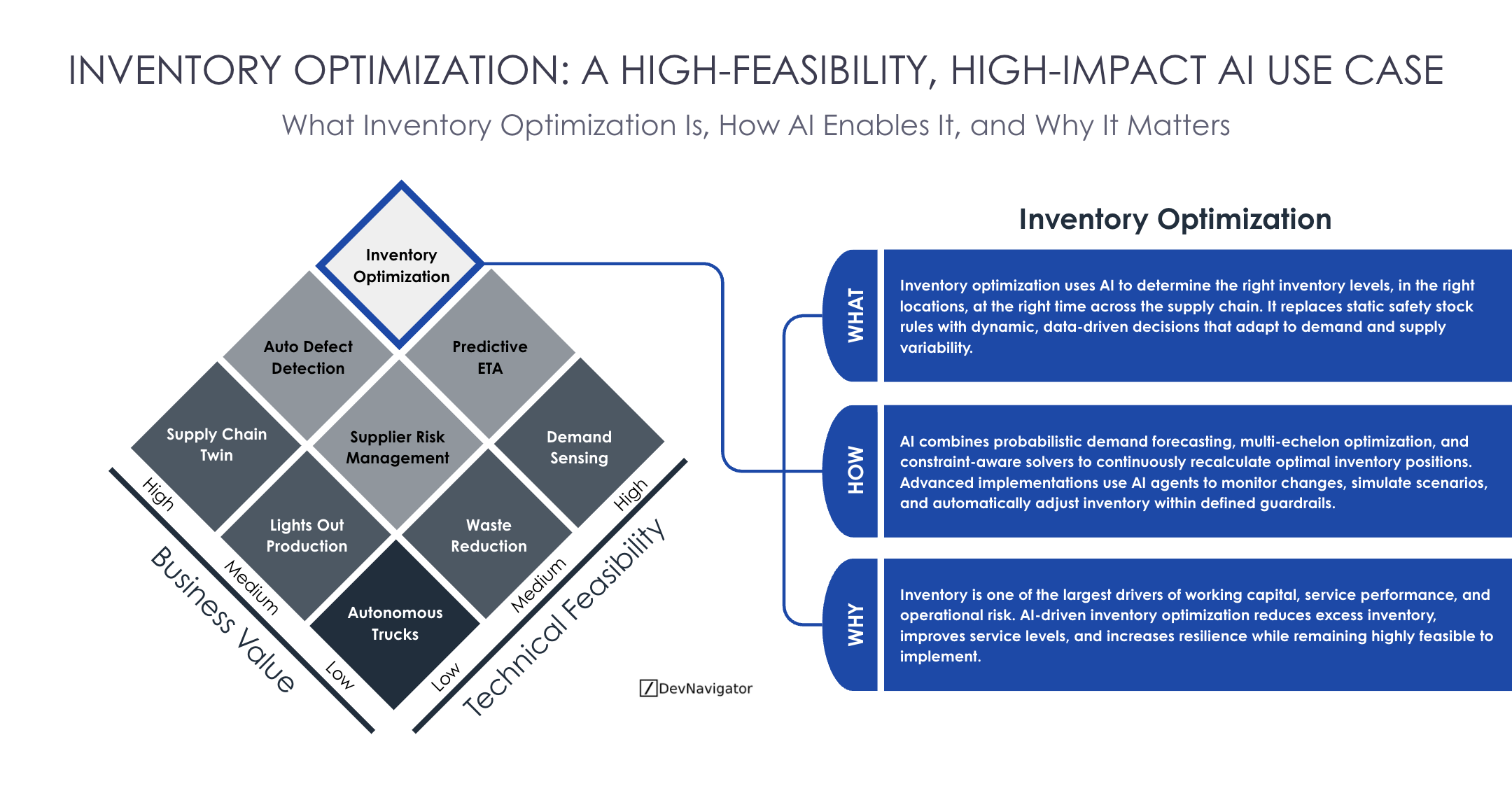
Inventory Optimization has quietly become one of the most effective ways organizations turn artificial intelligence into measurable business value. Unlike experimental AI initiatives, Inventory Optimization is grounded in mature data, proven methods, and clear operational outcomes. This article explains why Inventory Optimization consistently ranks as a high-feasibility, high-impact AI use case, how it works in practice, and why leaders increasingly prioritize it as a foundation for supply chain transformation.
Table of Contents
Executive Takeaways
- Inventory Optimization delivers fast ROI by reducing excess inventory while maintaining or improving service levels.
- AI makes Inventory Optimization adaptive, shifting it from static planning to continuous decision-making under uncertainty.
- This use case is highly feasible because it builds on existing ERP, demand, and supply chain data already in place.
Expanded Insights
Why Inventory Optimization Ranks So Highly
Inventory sits at the center of cost, service, and operational risk. Too much inventory ties up working capital and increases obsolescence, while too little inventory leads to stockouts, expediting, and customer dissatisfaction. Inventory Optimization addresses this tension directly, which is why it consistently appears in the high business value, high technical feasibility quadrant of AI use case frameworks.
From a leadership perspective, Inventory Optimization is attractive because its outcomes are easy to measure. Improvements show up quickly in inventory turns, fill rates, working capital, and service performance. This clarity makes it easier to justify investment and scale adoption across the supply chain.
What Inventory Optimization Really Means in Practice
Traditional inventory planning relies on fixed safety stock formulas and periodic reviews. Inventory Optimization replaces this approach with dynamic decisions that reflect real-world uncertainty. Rather than asking how much inventory is needed on average, AI-driven Inventory Optimization asks how much inventory is needed to achieve a specific service level under varying demand and supply conditions.
The result is not a single inventory number, but a continuously updated inventory position that reflects current risk, constraints, and business priorities. This shift transforms inventory from a static buffer into a managed lever for performance.
How AI Enables Modern Inventory Optimization
AI plays a critical role by modeling uncertainty instead of ignoring it. Probabilistic demand forecasting allows Inventory Optimization systems to account for variability, seasonality, and demand shocks rather than relying on point estimates. These forecasts feed optimization models that balance inventory across multiple locations, suppliers, and distribution points.
Constraint awareness is equally important. Effective Inventory Optimization considers lead times, minimum order quantities, shelf life, storage capacity, and capital constraints simultaneously. Advanced implementations extend this capability further by introducing AI agents that monitor changes, simulate scenarios, and automatically adjust inventory decisions within predefined guardrails.
Why Feasibility Is Higher Than Many AI Use Cases
Inventory Optimization benefits from decades of operational research and supply chain modeling. The algorithms are well understood, the data is structured, and the integration points with ERP, WMS, and planning systems already exist. In most cases, the technical challenge is not building new models but connecting systems and aligning decision workflows.
Because the scope is well defined, Inventory Optimization projects tend to scale more reliably than exploratory AI initiatives. This combination of maturity and practicality explains why Inventory Optimization often serves as an entry point for broader AI adoption in operations.
Business Impact Leaders Actually See
When implemented correctly, Inventory Optimization reduces excess and obsolete inventory while maintaining service levels. It improves resilience by allowing organizations to respond faster to supplier disruptions and demand volatility. Over time, it also enables better scenario planning, allowing leaders to understand tradeoffs before committing capital.
Perhaps most importantly, Inventory Optimization shifts decision-making from periodic planning cycles to continuous control. This creates the foundation for more advanced agent-driven supply chain capabilities without requiring a full transformation upfront.
Inventory Optimization as a Strategic AI Foundation
Inventory Optimization is not just a tactical improvement. It establishes the data, governance, and trust needed for AI-driven decision-making across the supply chain. Organizations that succeed here are better positioned to extend AI into demand sensing, supplier risk management, and autonomous planning.
For leaders looking to move beyond experimentation, Inventory Optimization remains one of the most practical and impactful AI use cases available today.