

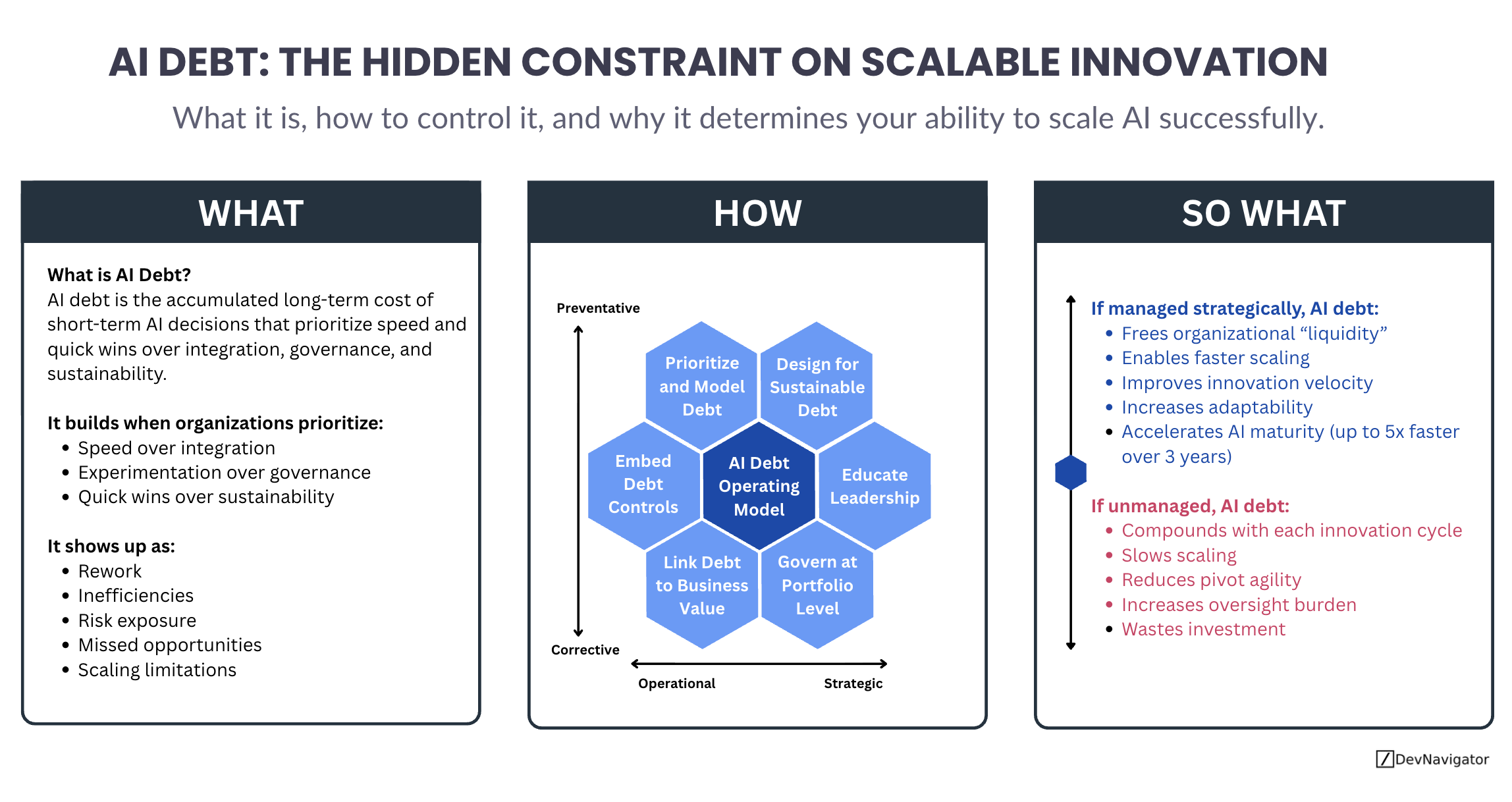
AI debt is becoming one of the most overlooked barriers to enterprise AI success. As organizations accelerate experimentation, they often accumulate structural weaknesses that limit integration, governance, and long-term scalability. Left unmanaged, AI debt compounds with each innovation cycle. Managed strategically, it becomes a lever for faster maturity and stronger innovation outcomes. This article explains what AI debt is, why it builds, and how to govern it through a practical operating model.
Table of Contents
Executive Takeaways
- AI debt is the accumulated long-term cost of short-term AI trade-offs that prioritize speed over sustainability.
- Without intentional governance, AI debt compounds across innovation cycles and limits scalability.
- Organizations that manage AI debt strategically improve agility, accelerate maturity, and unlock sustainable innovation.
Expanded Insights
What Is AI Debt?
AI debt is the long-term constraint created by short-term AI decisions. When organizations prioritize rapid deployment, experimentation, or quick wins over integration, governance, and architectural sustainability, they accumulate AI debt.
This is not a failure. AI debt is inevitable in any organization actively deploying AI systems. Models evolve faster than governance structures. Platforms change faster than operating models. As teams move quickly to demonstrate value, they introduce dependencies, fragmented architectures, and inconsistent standards.
AI debt shows up in familiar ways. Rework increases. Scaling becomes slower than expected. Oversight burdens grow. Innovation velocity stalls because teams spend more time fixing foundations than building new capabilities.
The problem is not that AI debt exists. The problem is that unmanaged AI debt compounds.
Why AI Debt Compounds Over Time
Every innovation cycle introduces new complexity. A new model is added. A new use case is deployed. A new vendor is integrated. Each decision introduces trade-offs.
In isolation, these trade-offs seem manageable. Across a portfolio, they accumulate.
AI debt rarely stays contained within a single use case. A governance shortcut in one initiative creates review bottlenecks elsewhere. A poorly integrated model limits reuse. Fragmented data pipelines reduce portability. Over time, AI debt constrains the organization’s ability to pivot, scale, or reinvest.
This compounding effect is what makes AI debt dangerous. Organizations that ignore it find themselves with dozens of promising pilots that never mature into scalable systems.
The AI Debt Operating Model
Managing AI debt requires more than technical clean-up. It requires an operating model that addresses both prevention and correction.
First, organizations must design for sustainable debt. Not all AI debt is harmful. Some trade-offs are strategic. The goal is not zero AI debt but intentional AI debt aligned with business priorities.
Second, leadership education is essential. When executives understand AI debt as a strategic trade-off rather than a technical nuisance, decisions improve. Investment pacing, portfolio sequencing, and architectural standards become more deliberate.
Third, debt controls must be embedded into the AI lifecycle. From design to deployment, each initiative should assess how it contributes to or reduces existing AI debt. This includes governance checkpoints, architectural reviews, and reuse standards.
Fourth, AI debt must be governed at the portfolio level. Without enterprise oversight, localized fixes create new constraints elsewhere. Portfolio managers need visibility into where AI debt accumulates and where it can be strategically repaid.
Finally, AI debt should be linked directly to business value. Debt repayment efforts should prioritize areas that unlock reuse, improve flexibility, or accelerate time to value. Not all AI debt deserves immediate attention. The highest impact debt should be addressed first.
The Strategic Upside of Managing AI Debt
When AI debt is managed intentionally, it becomes a lever rather than a liability.
Organizations free up what can be described as operational liquidity. Systems become easier to adapt. Scaling accelerates because integration pathways are clearer. Innovation velocity increases because teams build on stable foundations rather than repairing unstable ones.
Conversely, unmanaged AI debt compounds. Scaling slows. Oversight burdens grow. Pivot agility declines. Investments produce diminishing returns because structural constraints limit impact.
The difference between these outcomes is not technological capability. It is governance discipline.
AI debt is not a temporary phase of maturity. It is a structural reality of AI transformation. Organizations that recognize this and build systems to manage AI debt proactively will mature faster and innovate more sustainably.
AI debt will exist in every enterprise deploying AI. The question is whether it remains hidden and compounding, or governed and strategic. That distinction determines whether AI scales.