

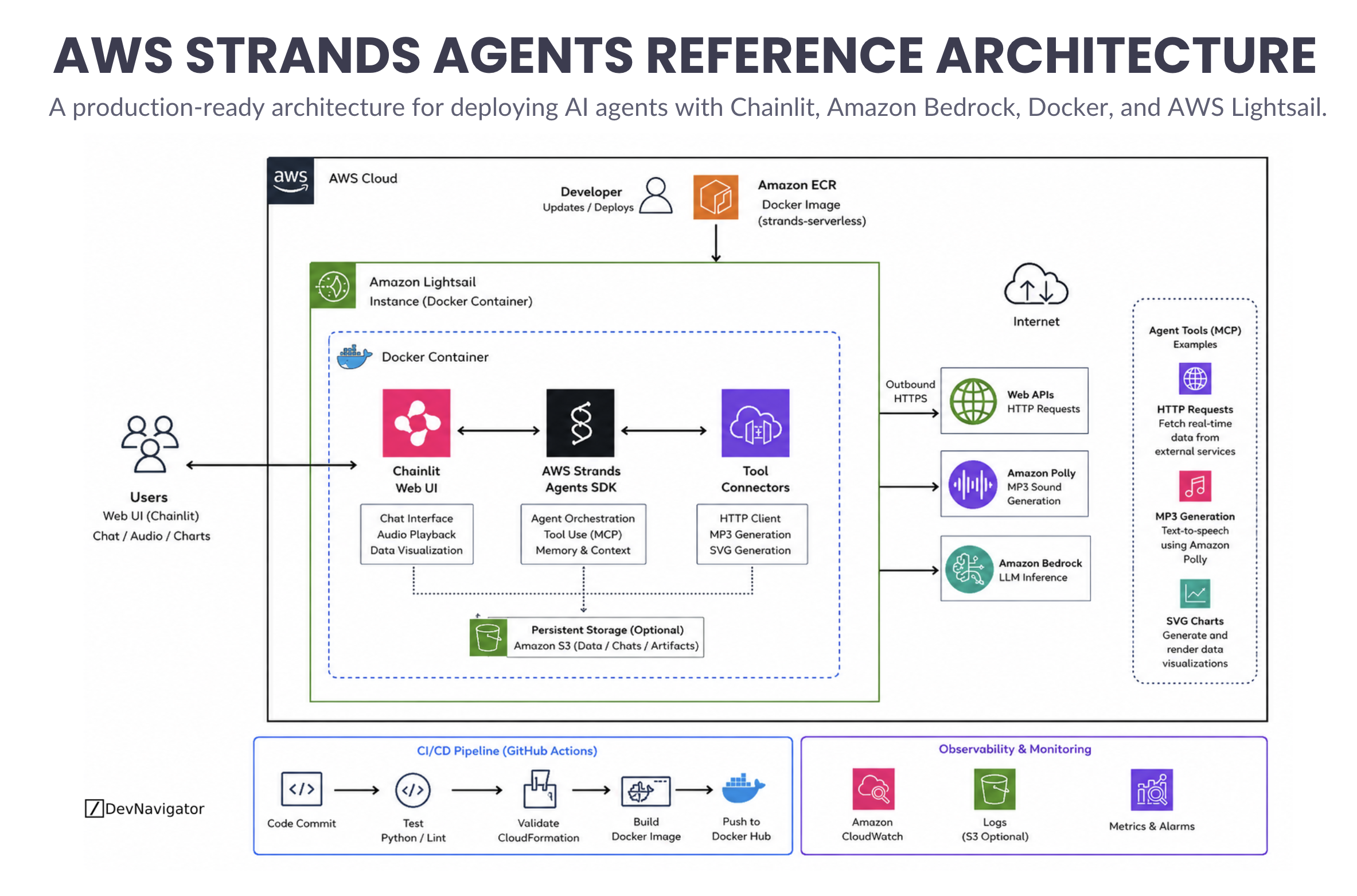
As AI agents move from prototypes into production, the focus shifts from prompt engineering to architecture. A production deployment requires more than a language model. It needs a user interface, orchestration, tool integration, deployment automation, monitoring, and secure cloud infrastructure.
This AWS Strands Agents reference architecture demonstrates how these components work together in a lightweight deployment. Running inside a Docker container on Amazon Lightsail, the solution combines the AWS Strands Agents SDK with Chainlit for the user interface, Amazon Bedrock for foundation models, Amazon Polly for speech generation, and external tools accessed through secure APIs. The result is a practical blueprint for building intelligent applications that can reason, call tools, and deliver rich user experiences.
Table of Contents
Executive Takeaways
- AWS Strands Agents provides the orchestration layer that coordinates reasoning, tool execution, and model interactions rather than acting as the language model itself.
- A complete AI agent platform requires multiple services including user interfaces, tool integrations, deployment automation, monitoring, and persistent storage in addition to foundation models.
- Containerizing AWS Strands Agents with Docker enables consistent deployments while AWS services such as Bedrock, Polly, CloudWatch, and S3 provide scalable cloud capabilities.
Expanded Insights
The Architecture Starts with the User Experience
Every AI application begins with how users interact with it. In this architecture, AWS Strands Agents is exposed through Chainlit, an open source web interface designed for conversational AI applications.
Chainlit provides streaming chat responses, support for multimedia, file uploads, and interactive visualizations without requiring developers to build a front end from scratch. Users simply open a browser and interact with the agent while the underlying infrastructure remains hidden.
This separation allows developers to improve the agent independently from the user interface.
AWS Strands Agents Orchestrates the Workflow
The center of the architecture is the AWS Strands Agents SDK.
Rather than generating every response directly, the SDK coordinates the work required to solve a request. Depending on the task, it may invoke one or more tools, retrieve information from external services, call a foundation model hosted in Amazon Bedrock, and combine those results into a single response.
This orchestration model allows agents to perform multi-step reasoning while remaining modular. New tools can be added without redesigning the entire application.
Tools Extend the Agent Beyond the LLM
Large language models are powerful, but they cannot retrieve live information or perform actions on their own.
This architecture demonstrates how AWS Strands Agents extends those capabilities through external tools. The example includes HTTP requests for retrieving live data, SVG generation for visualizations, and Amazon Polly for converting text into speech.
In enterprise environments, these same tool interfaces could connect to business systems, databases, APIs, or Model Context Protocol (MCP) servers. The architecture remains the same while the tools evolve with business requirements.
Amazon Bedrock Provides Model Flexibility
Instead of coupling the application to a single language model, the architecture connects AWS Strands Agents to Amazon Bedrock.
Bedrock provides managed access to multiple foundation models through a common interface. This allows organizations to evaluate different models without redesigning the application architecture. As new models become available, they can often be adopted with minimal changes to the surrounding infrastructure.
Keeping the orchestration layer separate from the model layer also makes the overall solution easier to maintain.
Containerized Deployment Simplifies Operations
The entire application runs inside a Docker container hosted on Amazon Lightsail.
Containerization ensures that development, testing, and production environments behave consistently. Updates become straightforward because developers only need to build a new container image and publish it through a CI/CD pipeline.
The reference architecture illustrates an automated workflow using GitHub Actions to test code, validate infrastructure templates, build Docker images, and publish updated deployments. This approach reduces manual deployment effort and improves repeatability.
Monitoring Completes the Production Story
A production AI application requires operational visibility in addition to intelligent responses.
The architecture incorporates Amazon CloudWatch for monitoring, logging, and alerting, while Amazon S3 can optionally store generated artifacts, uploaded files, or conversation assets. These services help teams troubleshoot failures, monitor application health, and understand how the agent is being used over time.
Observability is often overlooked during early experimentation but becomes essential as AI applications reach production workloads.
Building Practical AI Agents
The value of AWS Strands Agents is not limited to language generation. Its strength lies in orchestrating foundation models, external tools, and cloud services into a cohesive application.
This reference architecture demonstrates a practical deployment pattern that is simple enough for individual developers yet flexible enough to extend into larger enterprise environments. As organizations increasingly adopt agentic AI, architectures like this provide a solid foundation for building reliable, maintainable, and scalable intelligent applications.