


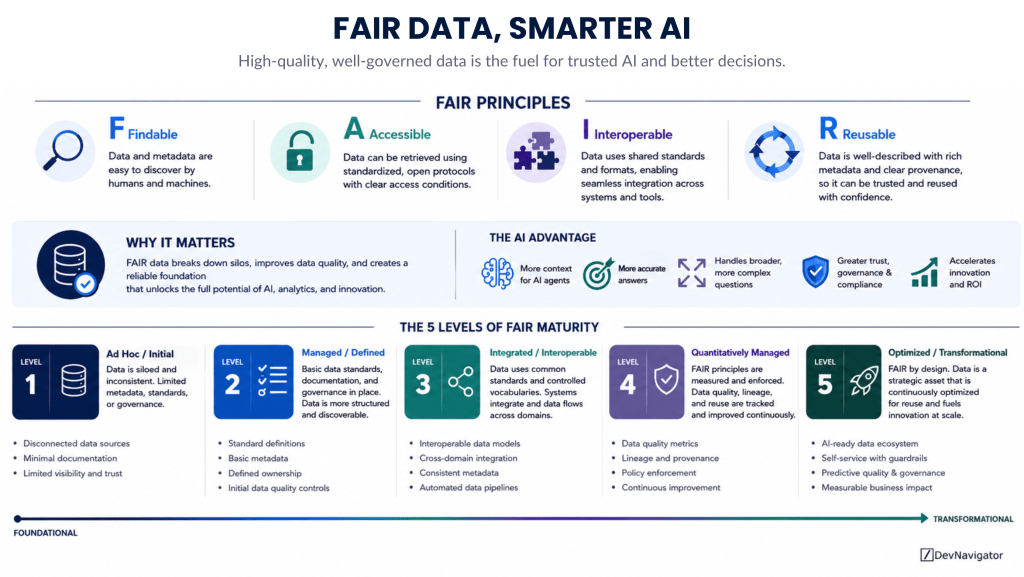
The FAIR Data Framework has been around since 2016, but the rise of AI agents has made its underlying principles more important than ever. FAIR stands for Findable, Accessible, Interoperable, and Reusable. At its core, the framework asks a simple question: can people and machines reliably discover, understand, access, and reuse the information an organization already has?
That question becomes critical when AI agents are expected to work across enterprise systems. Better models alone cannot compensate for fragmented data, inconsistent definitions, missing metadata, or information that cannot be reliably connected. FAIR data creates the foundation that allows AI to work with broader context and produce more useful answers.
Table of Contents
Executive Takeaways
- FAIR data was designed for machines as well as people. Machine-readable metadata, standardized access, shared semantics, and provenance make enterprise information easier for AI systems to discover and interpret.
- Better context can improve AI performance. When agents can retrieve relevant information across systems and understand how that information relates, they can address broader questions with stronger grounding.
- FAIR is a progression, not a binary state. Organizations can progressively move from siloed data toward an AI-ready data ecosystem built around standards, interoperability, governance, and reuse.
Strategic Insights
FAIR Was Built for a Machine-Driven World
The FAIR Data Framework originated from a need to make digital information easier to discover and reuse. What makes the framework especially relevant today is that FAIR was never designed only around human users. Machine-actionability is central to the concept.
Findable means data and metadata can be discovered. Accessible means they can be retrieved through defined protocols and access conditions. Interoperable means different datasets and systems can work together using common representations and vocabularies. Reusable means the data carries enough description, provenance, and context to be confidently used again. Those characteristics closely align with what modern AI agents need.
AI Agents Need More Than Access to Data
Connecting an AI agent to a database does not automatically give it useful context.
An organization might have thousands of tables, documents, applications, APIs, and data products. The agent still needs to determine what information exists, what it means, which source is authoritative, how different concepts relate, and whether it has permission to use them. The FAIR Data Framework addresses many of these problems upstream.
Rich metadata improves discovery. Common definitions improve interpretation. Interoperability allows information to move across systems. Provenance helps establish where information originated. Access controls establish how it can be retrieved. The result is not simply more data available to AI. It is data that is easier for AI systems to navigate and use appropriately.
Better Data Expands What Agents Can Answer
This becomes increasingly important as organizations move from simple copilots toward agents expected to answer cross-functional questions.
Consider an agent asked why production performance declined last quarter. Answering that question might require manufacturing data, maintenance records, quality events, supply information, operating procedures, and historical context. When those sources remain disconnected and poorly described, the agent has to operate across fragmented context.
As FAIR principles mature, the information environment becomes easier to navigate. Shared metadata, common vocabularies, connected data models, and documented provenance allow agents to retrieve evidence from multiple domains and assemble a more complete view of the problem. This is where FAIR data begins to become an AI capability rather than simply a data-management practice.
A Practical Five-Level FAIR Maturity Model
Organizations do not become FAIR overnight. A useful way to think about adoption is as a five-level maturity progression.
Level 1: Ad Hoc / Initial. Data remains siloed, documentation is limited, and standards vary across systems.
Level 2: Managed / Defined. Ownership, metadata, definitions, and basic data-quality controls begin to create consistency.
Level 3: Integrated / Interoperable. Common models, vocabularies, metadata standards, and automated pipelines allow information to flow across domains.
Level 4: Quantitatively Managed. Data quality, lineage, provenance, policy enforcement, and reuse are measured and continuously improved.
Level 5: Optimized / Transformational. FAIR principles are embedded by design. Data becomes an enterprise asset that can be safely discovered and reused by people, applications, analytics, and AI agents.
This five-level model is not part of the formal FAIR specification. It is a practical way to translate FAIR principles into an enterprise transformation journey.
FAIR Data Becomes Part of the AI Architecture
The larger shift is that enterprise data strategy and enterprise AI strategy are converging. AI agents need context. Context depends on discoverable information, metadata, relationships, semantics, provenance, permissions, and reusable knowledge. These are not capabilities that should be reconstructed separately for every AI use case. They should become part of the enterprise data foundation.
That changes the role of the FAIR Data Framework. FAIR is no longer valuable only because it makes data easier to manage or share. It provides a blueprint for making enterprise information increasingly machine-actionable. As AI moves deeper into enterprise workflows, organizations with FAIRer data will be better positioned to give their agents the context they need to reason across increasingly complex business problems.