

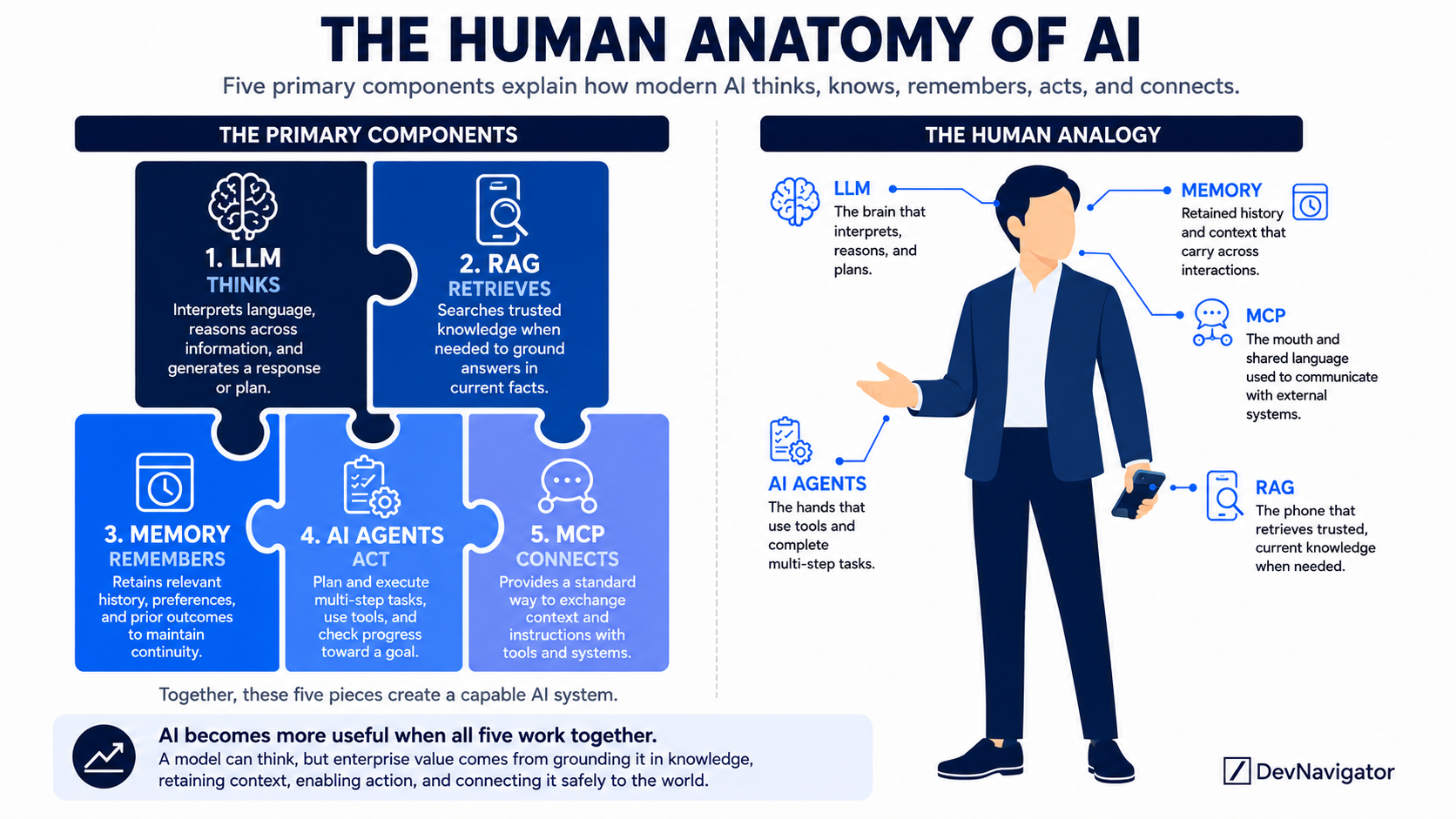
Modern AI is often described as if the model does everything. It answers questions, searches for information, recalls prior conversations, completes tasks, and connects to other systems. But the model is only one component within a larger AI system architecture.
A more useful way to understand modern AI is to compare it to a person. The large language model acts like the brain. Retrieval-augmented generation provides access to external knowledge. Memory preserves relevant history. AI agents coordinate actions. Model Context Protocol creates a standard way to connect the system with external tools and data. Each component serves a different purpose. The real value appears when all five work together. In this article, we break down the AI system architecture into the basic building blocks for everyone to understand.
Table of Contents
Executive Takeaways
- An LLM provides intelligence, but intelligence alone does not create a complete AI system.
- RAG and memory play different roles: RAG retrieves external knowledge, while memory maintains continuity across interactions.
- AI agents and MCP turn a conversational model into a system capable of completing work across enterprise applications.
Strategic Insights
The LLM Is the Brain That Thinks
A large language model is the reasoning and language engine at the center of the AI system architecture. It interprets instructions, identifies patterns, evaluates information, generates content, and proposes a response or plan.
The brain analogy is useful, but it also reveals a limitation. A brain cannot automatically know every current fact or interact with every external system. Similarly, an LLM is constrained by its training, available context, and the tools it can access. It can reason about the information it receives, but it should not be treated as a complete knowledge repository or execution platform.
RAG Is the Phone That Retrieves Knowledge
Retrieval-augmented generation, or RAG, gives an AI system access to information beyond the model’s original training. It searches indexed sources such as documents, policies, research, databases, or knowledge bases and places relevant information into the model’s context.
This makes RAG comparable to having internet access on a phone. When a person does not know something, they can look it up. However, enterprise RAG does not necessarily search the public internet. It often retrieves from controlled and approved organizational sources.
RAG makes an AI system architecture more current and grounded, but its performance depends on the quality of the underlying content, metadata, retrieval process, and access controls.
Memory Preserves Continuity
Memory allows an AI system to retain relevant information across interactions. This may include user preferences, prior decisions, completed steps, important facts, or the state of an ongoing task.
RAG retrieves information from a knowledge source. Memory recalls what has happened within a relationship or workflow. That distinction matters. RAG might retrieve a company travel policy, while memory recalls the destination the employee selected during an earlier conversation.
Effective memory makes AI feel less transactional. It allows the system to continue work rather than restarting every interaction from zero. It must also be governed carefully so that retained information is relevant, accurate, secure, and removable when necessary.
AI Agents Are the Hands That Act
AI agents move the system from generating answers to completing work. An agent can interpret a goal, develop a plan, select tools, execute steps, inspect results, and adjust its approach.
The hands analogy captures this shift. The LLM determines what should happen, while the agent coordinates how the work gets done. An agent might research a supplier, compare proposals, update a system, generate a report, and route it for approval.
This autonomy introduces risk. Organizations need clear permissions, human approval points, monitoring, and evaluation. The objective is not unrestricted action. It is controlled delegation within defined boundaries.
MCP Is the Mouth That Connects
Model Context Protocol, or MCP, provides a standardized method for AI applications to connect with external tools, data sources, and workflows. The official MCP documentation compares it to a USB-C port for AI applications.
Within the human analogy, MCP acts like the mouth and shared language used to communicate with the outside world. It gives the AI system a consistent way to discover available capabilities, request information, and invoke tools.
MCP does not perform the reasoning or complete the task by itself. It creates the connection layer through which the model or agent can communicate with other systems. Together, these five components form a practical AI system architecture. The LLM thinks. RAG retrieves. Memory remembers. Agents act. MCP connects.
For leaders, the central lesson is simple: choosing a powerful model is only the beginning. Enterprise value comes from designing the complete system around it.