

Abstract
Agent Skills give AI agents reusable instructions for specific jobs, helping them apply the context that makes work effective inside an organization. Vercel’s latest registry report shows rapid adoption, with workflow skills prominent among widely installed packages. For leaders, the opportunity is to make company knowledge usable during execution: decision rules, exceptions, quality standards, and the reasoning experienced employees apply. That knowledge can improve task performance when it is relevant, current, and tested. The strategic question is how to turn expertise into dependable outcomes without treating instructions as a guarantee of accuracy.
Table of Contents
Executive Takeaways
- Preserve company expertise. Reusable instructions can make tribal knowledge and decision context available across teams and workflows.
- Improve contextual accuracy. Relevant company rules can help agents produce outputs that better fit business requirements.
- Build confidence through evidence. Wider enterprise use should depend on demonstrated performance, accountable ownership, and reliable execution.
Strategic Insights
1. Agent Skills are becoming a reusable knowledge layer
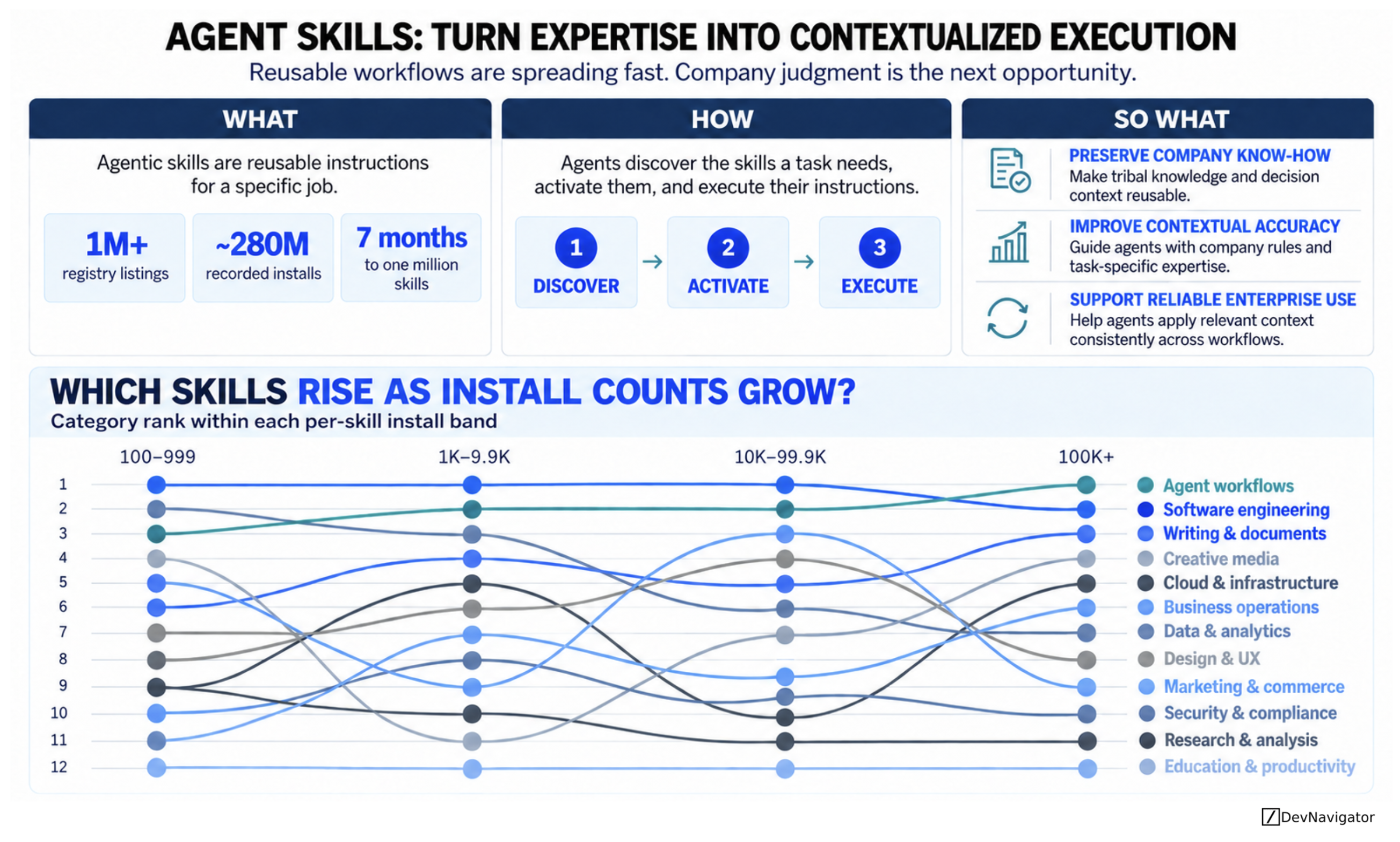
In its September 25, 2026 State of agent skills report, Vercel says skills.sh reached more than one million listings and nearly 280 million recorded installs in seven months. Agent workflows lead the category ranking among listings with at least 100,000 installs.
The accompanying ranking chart compares categories across install bands; it does not track adoption over time. Vercel also reports that cross-industry skills account for 87.5% of installs in its classified sample. These figures describe registry activity, rather than unique users or proven business value.
The leadership implication is practical: recurring work creates opportunities for reusable guidance. A company can identify tasks where employees repeatedly explain the same requirements and package that expertise for agents.
2. Discovery, activation, and execution bring context into the task
The Agent Skills documentation describes a folder containing a SKILL.md file, with optional scripts, references, and assets. Agents first discover available skills through their names and descriptions, then activate relevant instructions and execute the task using supporting resources when needed.
This selective loading lets an agent retain access to many workflows without placing every instruction into every interaction.
Consider a monthly performance review. A skill could specify approved KPI definitions, the reporting template, how to distinguish temporary variation from a persistent trend, and which unresolved questions require escalation. The agent still needs access to trustworthy operational data.
Agent Skills complement the capability access discussed in DevNavigator’s three MCP patterns for enterprise AI. A useful design separates the systems an agent can access from the guidance it follows when using them.
3. Company judgment can improve contextual accuracy
Experienced employees often know which exceptions matter, which comparisons are misleading, and what evidence supports a recommendation. That judgment can be difficult to recover from a collection of documents alone.
Agent Skills offer a way to capture those working rules explicitly. In a supply-chain review, for example, an instruction could require the agent to distinguish an inventory shortage from material awaiting quality release before recommending replenishment.
The potential benefit is a more appropriate decision, fewer avoidable corrections, and a clearer explanation of the recommendation. This improves the performance of the agent system; it does not change the model’s underlying training.
Instructions can also encode outdated assumptions or individual bias. Subject-matter review should therefore check whose judgment is represented, when it applies, and where uncertainty requires human involvement.
4. Reliable enterprise use depends on measured improvement
A useful pilot starts with one recurring workflow and a clear success criterion. Run comparable tasks with and without the skill, keeping the model, tools, and input data consistent. Measure factual errors, compliance with business rules, rework, completion time, and escalation quality.
Include unusual cases. A reporting skill that handles routine inputs well may still fail when definitions conflict or evidence is missing. Evaluate whether the agent recognizes those conditions.
Ownership matters because it keeps the captured knowledge useful as policies and processes change. Version reviews and regression checks support that outcome rather than becoming ends in themselves.
The business case for Agent Skills is stronger when teams can show that reusable context improves execution. Start where company judgment materially affects results, measure the difference, and expand when the evidence supports more dependable work.