

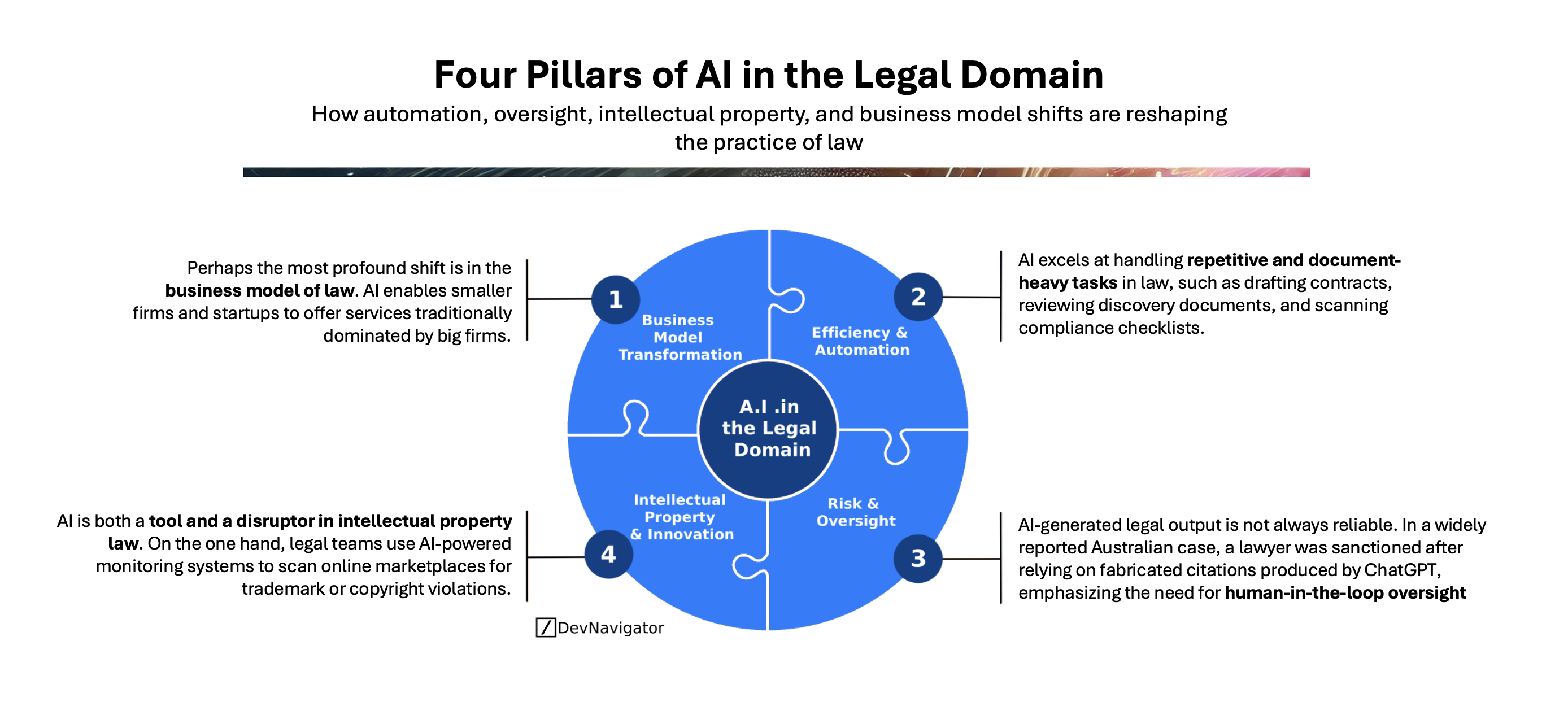
AI in the Legal Domain is no longer a future concept or a niche experiment. It is actively reshaping how legal services are delivered, priced, governed, and protected. From automating document-heavy work to redefining who can compete in the legal market, AI is forcing law firms, legal departments, and regulators to rethink long-standing assumptions. This article breaks down the four most critical pillars driving this transformation and explains why AI in the Legal Domain represents both a competitive advantage and a structural risk if adopted without discipline.
Table of Contents
Executive Takeaways
- AI in the Legal Domain is changing who can compete, enabling smaller firms to challenge large incumbents through technology-driven leverage rather than headcount alone.
- Automation delivers speed, but not judgment, making human oversight a non-negotiable requirement for responsible AI use in legal work.
- Intellectual property is both enabled and threatened by AI, creating new tools for enforcement while introducing unresolved legal and ethical questions.
Expanded Insights
Business Model Transformation and Market Disruption
AI in the Legal Domain is fundamentally altering the business model of legal services. Traditionally, scale favored large firms with deep benches of associates billing by the hour. AI changes that equation. Tasks that once required teams of junior lawyers can now be completed faster with AI-assisted drafting, research, and review. This allows smaller firms and startups to offer competitive services at lower cost while maintaining acceptable margins.
This shift does not eliminate expertise. Instead, it reallocates value away from time spent and toward judgment, specialization, and client trust. Firms that adopt AI strategically can unbundle services, introduce alternative pricing models, and focus senior talent on high-impact advisory work. Those that resist risk being undercut by leaner, tech-enabled competitors. AI in the Legal Domain is therefore less about replacing lawyers and more about redefining how legal value is delivered.
Efficiency and Automation at Scale
Efficiency and automation represent the most visible impact of AI in the Legal Domain. Legal work is inherently document-heavy, making it well suited for machine assistance. AI systems can rapidly draft standard contracts, summarize lengthy filings, review discovery materials, and scan compliance checklists with speed that no human team can match.
The gains are real. Cycle times shrink, costs decline, and lawyers spend less time on repetitive tasks. However, automation works best when applied to well-defined, low-ambiguity processes. AI in the Legal Domain excels at pattern recognition and language generation, not legal reasoning or contextual judgment. Treating AI as an infallible source of truth introduces risk rather than efficiency.
Firms that succeed with automation clearly define where AI adds value and where human expertise remains essential. Used correctly, AI becomes a productivity multiplier rather than a liability.
Risk, Oversight, and Professional Responsibility
Risk and oversight are the counterweight to efficiency in AI in the Legal Domain. High-profile cases have demonstrated that AI-generated legal output can be confidently wrong. Fabricated citations, incorrect interpretations, and subtle hallucinations pose serious professional and ethical risks.
Legal responsibility does not shift to the tool. Lawyers remain accountable for the accuracy of their work, regardless of whether AI assisted in its creation. This reality makes human-in-the-loop oversight mandatory. AI outputs must be reviewed, validated, and contextualized before reaching clients, courts, or regulators.
From a governance perspective, AI in the Legal Domain requires new internal controls, training standards, and usage policies. Firms must define acceptable use, document review processes, and escalation paths when AI outputs raise uncertainty. Oversight is not an obstacle to adoption; it is what enables AI to be used safely at scale.
Intellectual Property Innovation and Enforcement
Intellectual property is one of the most complex areas affected by AI in the Legal Domain. On the enforcement side, AI-powered monitoring systems can scan digital marketplaces, social platforms, and global registries to detect potential trademark or copyright violations far more efficiently than manual methods. This gives rights holders unprecedented visibility and reach.
At the same time, AI introduces new questions around ownership, authorship, and originality. When AI systems generate content, designs, or code, existing legal frameworks struggle to assign responsibility and rights. Courts and regulators are still catching up, creating uncertainty that legal teams must navigate carefully.
AI in the Legal Domain therefore acts as both an enforcement accelerator and a legal stress test. Firms that understand both sides will be better positioned to advise clients as precedents evolve.
Final Thought
AI in the Legal Domain is not a single tool or trend. It is a structural shift touching business models, workflows, ethics, and intellectual property. The firms that win will not be those that adopt AI the fastest, but those that adopt it deliberately, govern it responsibly, and align it with professional judgment.