

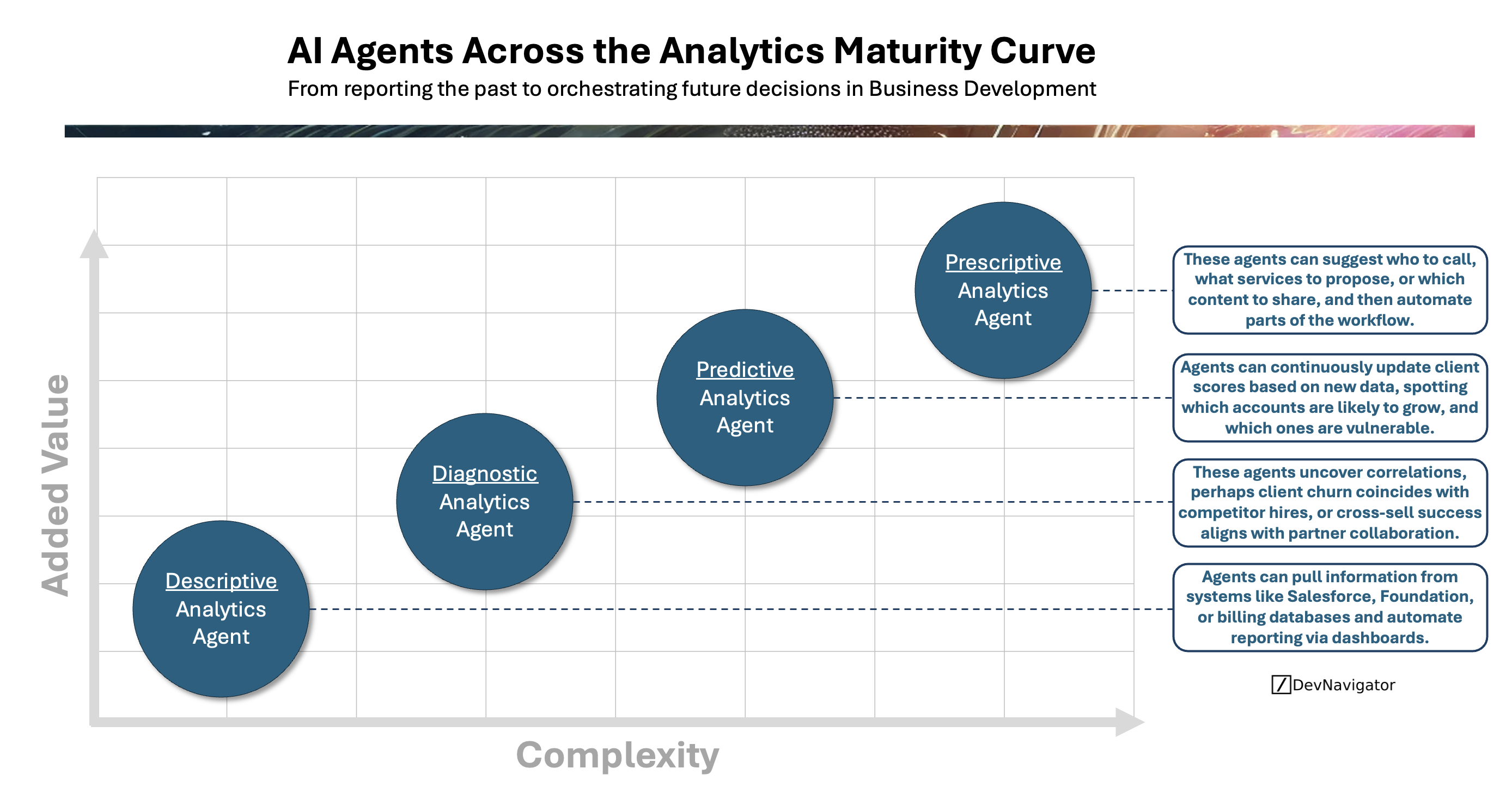
AI Analytics Agents are rapidly changing how organizations move from basic reporting to intelligent decision orchestration. Rather than treating analytics as a static capability, modern enterprises are embedding AI Analytics Agents across the analytics maturity curve to continuously learn, predict, and act. This shift is not just about better models or dashboards. It represents a structural change in how data is translated into business value. By understanding how AI Analytics Agents evolve from descriptive to prescriptive roles, leaders can make smarter investments, set realistic expectations, and scale impact without unnecessary complexity.
Table of Contents
Executive Takeaways
- AI Analytics Agents unlock increasing business value as organizations progress along the analytics maturity curve, but each stage requires different data, governance, and operating models.
- Not every organization needs prescriptive AI Analytics Agents immediately; value is created by matching agent capability to business readiness.
- The biggest returns come when AI Analytics Agents are embedded into workflows, not treated as standalone analytics tools.
Expanded Insights
Descriptive Analytics Agents: Creating a Reliable View of the Past
At the foundation of the analytics maturity curve, AI Analytics Agents focus on descriptive analytics. These agents answer a simple but essential question: what happened. They pull data from operational systems such as CRM platforms, billing tools, or data warehouses and automate reporting through dashboards and summaries.
While descriptive AI Analytics Agents are the least complex, they provide critical value by standardizing metrics and reducing manual effort. Many organizations underestimate this stage, yet poor descriptive analytics often undermines every advanced initiative that follows. Without trusted historical data, predictive and prescriptive insights quickly lose credibility. At this level, AI Analytics Agents act as reliable narrators of the past, ensuring teams operate from a shared version of truth.
Diagnostic Analytics Agents: Explaining Why Outcomes Occurred
As organizations mature, AI Analytics Agents evolve into diagnostic roles. Here, the focus shifts from what happened to why it happened. Diagnostic agents analyze patterns, correlations, and anomalies across datasets to uncover drivers behind performance changes.
For example, a diagnostic AI Analytics Agent might reveal that customer churn aligns with competitor hiring activity or that cross sell success increases when certain partners are involved. These insights move analytics from passive reporting to active explanation. Importantly, diagnostic AI Analytics Agents still require strong human interpretation. They surface signals and relationships, but business leaders must contextualize findings before acting. This stage often delivers outsized value because it helps organizations move beyond intuition toward evidence based decision making.
Predictive Analytics Agents: Anticipating What Comes Next
Predictive AI Analytics Agents represent a meaningful leap in sophistication. These agents estimate future outcomes based on historical trends and real time signals. Rather than explaining the past, they forecast what is likely to happen next.
In business development or customer operations, predictive AI Analytics Agents can continuously update account health scores, identify growth opportunities, or flag vulnerable customers before issues surface. The key shift at this stage is timing. Predictive insights create value by enabling earlier intervention. However, predictive accuracy depends heavily on data quality, feature stability, and monitoring. Organizations that rush into predictive AI Analytics Agents without foundational discipline often struggle with trust and adoption.
Prescriptive Analytics Agents: Orchestrating Decisions and Actions
At the top of the analytics maturity curve, AI Analytics Agents become prescriptive. These agents not only predict outcomes but recommend actions and, in some cases, automate parts of the workflow. They might suggest which client to contact, what service to propose, or which content to share, based on predicted impact.
Prescriptive AI Analytics Agents operate closest to decision making, which makes governance, transparency, and human oversight essential. Their power lies in orchestration rather than automation alone. The most effective implementations keep humans in the loop for high risk decisions while allowing agents to handle routine optimization. This stage delivers the highest potential value, but only when organizations have earned it through maturity in earlier stages.
Aligning AI Analytics Agents With Business Readiness
The analytics maturity curve is not a race. AI Analytics Agents create value when their capabilities align with organizational readiness. Leaders should view maturity as a progression, not a checklist. Investing in prescriptive agents without stable descriptive and diagnostic foundations often leads to frustration rather than transformation.
Ultimately, AI Analytics Agents are not just analytics tools. They are operational capabilities that evolve alongside data, processes, and decision culture. Organizations that treat them as long term assets, rather than quick wins, are best positioned to convert complexity into sustained advantage.