

For more than six decades, Moore’s Law has served as a remarkably accurate predictor of computing progress, guiding how engineers, businesses, and policymakers think about technological advancement. While many have declared Moore’s Law “dead,” real-world data tells a more nuanced story. Transistor counts continue to climb, not just through traditional scaling, but through architectural innovation, specialized silicon, and system-level design. This article examines why Moore’s Law still holds strategic relevance today, what has changed beneath the surface, and why its influence on AI, data infrastructure, and enterprise innovation remains profound.
Table of Contents
Executive Takeaways
- Moore’s Law continues to describe long-term progress, even as the mechanisms behind transistor growth have evolved beyond simple miniaturization.
- The value of Moore’s Law has shifted from physics to strategy, shaping software efficiency, AI scalability, and hardware specialization.
- Organizations that understand Moore’s Law today focus on systems, not chips, aligning architecture, workloads, and economics to unlock real value.
Expanded Insights
The Historical Power of Moore’s Law
Moore’s Law, first articulated in the 1960s, observed that the number of transistors on a chip tends to double roughly every two years. What made Moore’s Law extraordinary was not just its accuracy, but its influence. It became a self-fulfilling roadmap for the semiconductor industry, aligning research, capital investment, and long-term planning across decades.
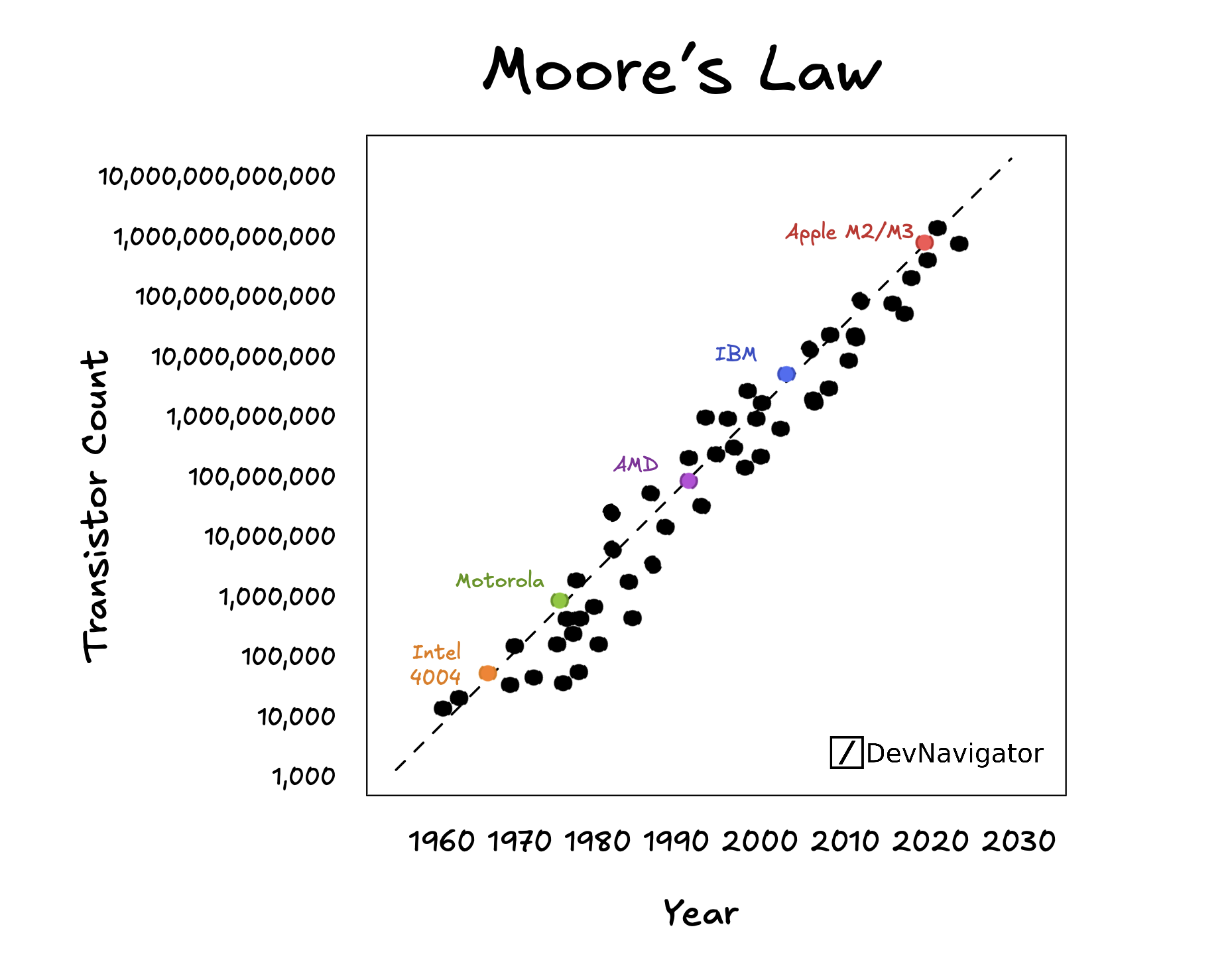
The visualization above shows this consistency clearly. From early processors like the Intel 4004 to modern system-on-chip designs, transistor counts have followed a steady upward trajectory. Even across different manufacturers and eras, the exponential trend holds. Moore’s Law was never about exact timing. It was about momentum, direction, and confidence in sustained progress.
Why Moore’s Law Was Declared “Dead”
The skepticism around Moore’s Law is understandable. Physical limits are real. Transistors are approaching atomic scales, manufacturing costs have skyrocketed, and power efficiency constraints have become harder to manage. Simple transistor shrinking no longer delivers the same cost or performance benefits it once did.
However, declaring Moore’s Law dead misunderstands what made it valuable in the first place. Moore’s Law was never a promise of infinite miniaturization. It was a statement about innovation keeping pace with ambition. The curve did not flatten. The methods changed.
How Moore’s Law Evolved Instead of Ending
Modern progress reflects a broader interpretation of Moore’s Law. Transistor growth now comes from advanced packaging, chiplets, 3D stacking, and heterogeneous architectures. Apple’s M-series chips are a clear example. Instead of chasing raw clock speed, they integrate massive transistor counts into tightly optimized systems designed for real workloads.
This evolution preserves the spirit of Moore’s Law. Transistors still scale, but more importantly, usable performance per watt and per dollar continues to improve. The exponential curve remains visible, even if the underlying physics looks very different than it did in the 1980s.
Moore’s Law and the Rise of AI Workloads
AI has become one of the strongest forces reinforcing Moore’s Law’s relevance. Training and inference workloads demand enormous computational density, memory bandwidth, and energy efficiency. General-purpose CPUs alone are no longer sufficient.
As a result, Moore’s Law now expresses itself through accelerators, GPUs, NPUs, and tightly coupled memory architectures. Transistor growth enables more parallelism, larger models, and faster experimentation cycles. Without Moore’s Law-level scaling, modern AI systems would be economically infeasible at scale.
The Strategic Meaning of Moore’s Law Today
For business leaders, Moore’s Law is no longer a hardware curiosity. It is a strategic signal. It explains why AI capabilities accelerate year over year, why cloud economics shift rapidly, and why software teams must continuously rethink efficiency.
Organizations that succeed do not simply wait for faster chips. They design systems that ride the curve intelligently, pairing algorithms, infrastructure, and data strategies with the realities of modern silicon. Moore’s Law still rewards those who plan ahead.
Why Moore’s Law Still Matters
Moore’s Law endures because innovation did not stop when physics became hard. It adapted. The exponential trend continues, not through one breakthrough, but through many coordinated advances across hardware and software.
As the chart shows, the story of Moore’s Law is not nostalgia. It is evidence. Computing power continues to grow, and with it, the potential for AI, automation, and scientific discovery. Understanding Moore’s Law today is less about counting transistors and more about recognizing how sustained progress reshapes what is possible.