

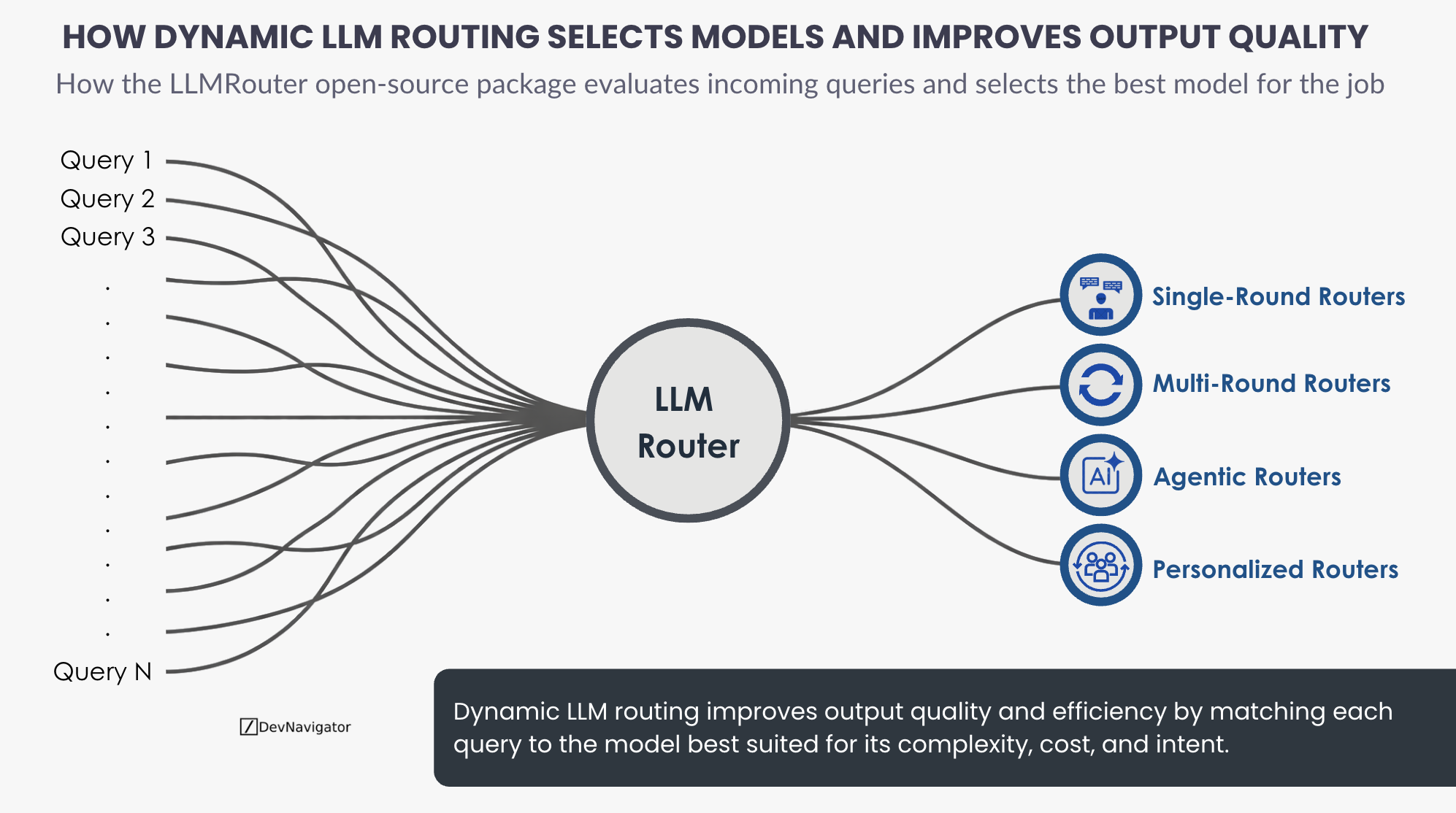
Dynamic LLM routing has emerged as a critical capability for teams deploying multiple language models at scale. Rather than relying on a single model for every task, dynamic LLM routing evaluates each incoming query/prompt and selects the model best suited to handle it. This approach improves output quality, controls cost, and enables more reliable AI systems. Using the open-source LLMRouter package as a reference point, this article explains how dynamic LLM routing works, why it matters, and how different routing strategies contribute to better results across real-world applications.
Table of Contents
Executive Takeaways
- Dynamic LLM routing improves output quality by matching each query to the model best aligned with its complexity, intent, and performance requirements.
- Dynamic LLM routing enables scalable multi-model systems, allowing teams to balance cost, latency, and accuracy without sacrificing reliability.
- Dynamic LLM routing is not a single technique, but a family of strategies ranging from simple single-round routing to multi-round, agentic, and personalized approaches.
Expanded Insights
What Dynamic LLM Routing Actually Does
Dynamic LLM routing refers to the process of evaluating an incoming query and deciding which language model should handle it before inference occurs. Instead of treating all queries the same, dynamic LLM routing introduces a decision layer that considers signals such as task type, estimated difficulty, historical performance, or user context. In practice, this means simple questions may be routed to smaller, faster models, while complex or multi-step requests are routed to more capable models. The result is higher overall output quality without unnecessary cost.
Why Dynamic LLM Routing Improves Output Quality
Output quality suffers when a single model is forced to handle every type of query. Some models excel at reasoning, others at speed, and others at conversation or domain-specific tasks. Dynamic LLM routing improves output quality by ensuring that each query is handled by a model designed for that type of work. Over time, this leads to fewer failures, more consistent responses, and better alignment between user intent and model capability. Importantly, this improvement comes from better orchestration rather than better prompting alone.
Single-Round Routing as the Foundation
Single-round routing represents the most straightforward form of dynamic LLM routing. In this approach, the router makes a decision based solely on the current query, often using embeddings, classifiers, or learned scoring functions. Models such as KNN-based, SVM-based, or neural network routers fall into this category. Single-round routing is fast, easy to deploy, and effective for many workloads, making it a practical starting point for teams adopting dynamic LLM routing.
Multi-Round and Agentic Routing for Complex Tasks
Not all queries can be accurately evaluated in a single pass. Multi-round and agentic routing extend dynamic LLM routing by allowing the router to consider conversation history, intermediate outputs, or follow-up reasoning steps. These approaches are particularly useful for complex workflows such as multi-turn conversations, planning tasks, or code generation. By incorporating additional context, dynamic LLM routing becomes more robust and better aligned with real user behavior.
Personalized Routing and User-Aware Decisions
Personalized routing introduces another layer of sophistication to dynamic LLM routing by incorporating user preferences or historical interactions. Rather than optimizing for global performance alone, the router adapts to individual users over time. This approach improves output quality by aligning model selection with user expectations, writing style preferences, or domain familiarity. While more complex to implement, personalized dynamic LLM routing represents a key step toward more adaptive and trustworthy AI systems.
Why Open-Source Dynamic LLM Routing Matters
The LLMRouter package demonstrates how dynamic LLM routing can be implemented in a transparent and extensible way. By supporting multiple routing strategies within a unified framework, it allows practitioners to experiment, benchmark, and evolve their routing logic without locking into a single vendor or model. This openness is essential for advancing best practices around dynamic LLM routing, especially as organizations move toward multi-model and agent-based AI architectures.