

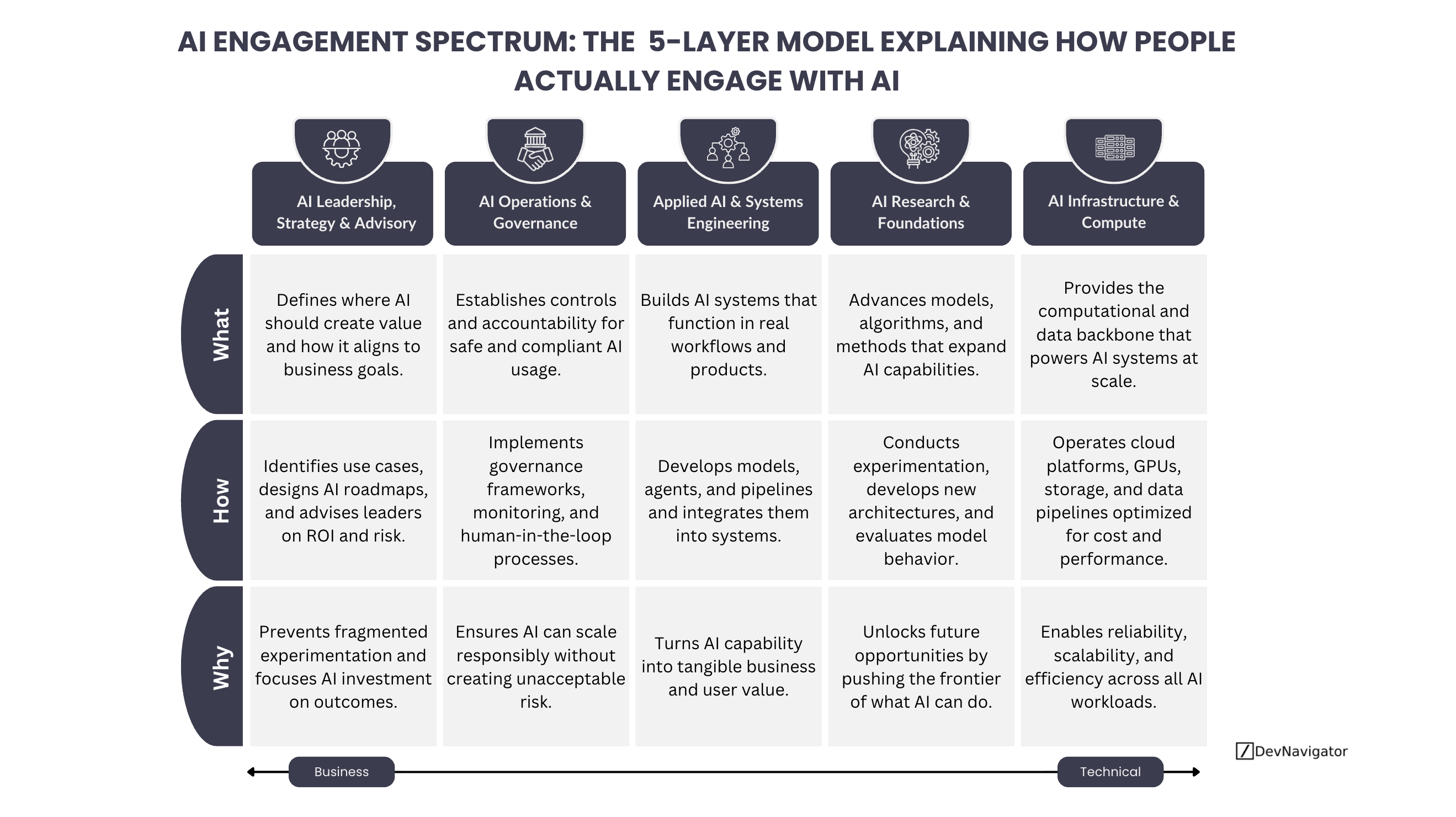
The conversation around artificial intelligence often collapses into a narrow debate about models, tools, or talent shortages. In practice, AI succeeds or fails based on how people engage with it across the organization. The AI Engagement Spectrum provides a clear five-layer model that explains where individuals and teams participate, from business strategy through infrastructure. Rather than viewing AI as a single discipline, this framework shows how value emerges when intent, control, execution, innovation, and scale are connected. Understanding the AI Engagement Spectrum helps leaders design better operating models, helps practitioners identify where they add value, and helps organizations avoid common failure modes in AI adoption.
Table of Contents
Executive Takeaways
- The AI Engagement Spectrum clarifies five distinct but interdependent ways people engage with AI, from business strategy to infrastructure and compute.
- AI impact depends on alignment across layers, not excellence in any single one.
- Most AI failures stem from gaps between strategy, governance, and applied execution rather than technical limitations.
Expanded Insights
Why the AI Engagement Spectrum Matters
AI is often discussed as a technology problem, but in reality it is an organizational coordination problem. Models do not create value on their own, and infrastructure does not define outcomes by itself. The AI Engagement Spectrum reframes AI as a system of human involvement. It explains how decisions, controls, engineering, discovery, and scale interact to produce real results. By making these layers explicit, organizations can better understand why some AI efforts stall while others compound value over time.
AI Leadership, Strategy, and Advisory
At the business end of the AI Engagement Spectrum sits strategy and advisory. This layer defines where AI should create value and how it aligns with organizational goals. Leaders operating here translate business problems into AI-relevant opportunities and decide what success looks like before any system is built. Strategy determines priorities, funding, ownership, and acceptable risk. Without this layer, AI initiatives fragment into disconnected experiments that struggle to justify their existence.
AI Operations, Governance, and Enablement
Governance is often misunderstood as a brake on innovation, but within the AI Engagement Spectrum it acts as an enabler of scale. This layer establishes accountability, controls, and oversight for how AI systems behave in production. Human-in-the-loop workflows, monitoring, escalation paths, and compliance mechanisms all live here. Governance ensures that AI can be trusted by users, regulators, and leadership. Organizations that skip this layer may move quickly at first, but they rarely sustain momentum.
Applied AI and Systems Engineering
The center of the AI Engagement Spectrum is where intent becomes reality. Applied AI and systems engineering teams build models, agents, and pipelines that operate inside real workflows. This work involves tradeoffs between accuracy, latency, cost, and usability. It also requires deep collaboration with domain experts and system owners. This layer is where AI becomes visible to users and where business value is either delivered or lost.
AI Research and Foundations
Research expands what AI can do, rather than what it should do today. In the AI Engagement Spectrum, research supports innovation by exploring new methods, architectures, and capabilities. Most organizations consume research rather than producing it, but understanding this layer matters. It explains why applied systems eventually hit limits and why selective investment in research can unlock new possibilities. Research acts as a future-facing option value rather than a near-term delivery engine.
AI Infrastructure and Compute
At the technical extreme of the AI Engagement Spectrum lies infrastructure and compute. This layer provides the computational and data backbone that powers all AI workloads. Cloud platforms, GPUs, storage, and data pipelines enable reliability, scalability, and efficiency. Infrastructure does not define strategy, but it constrains what is feasible. When infrastructure is weak, even strong applied teams struggle to deliver. When it is robust, AI systems can scale with confidence.
Connecting the Dots
The real power of the AI Engagement Spectrum lies in its directionality. Moving from strategy to infrastructure increases technical depth and execution detail. Moving from infrastructure back to strategy increases abstraction and business value. Organizations that succeed in AI deliberately connect these layers rather than optimizing them in isolation. AI maturity is less about owning cutting-edge models and more about coordinating people across the spectrum.