

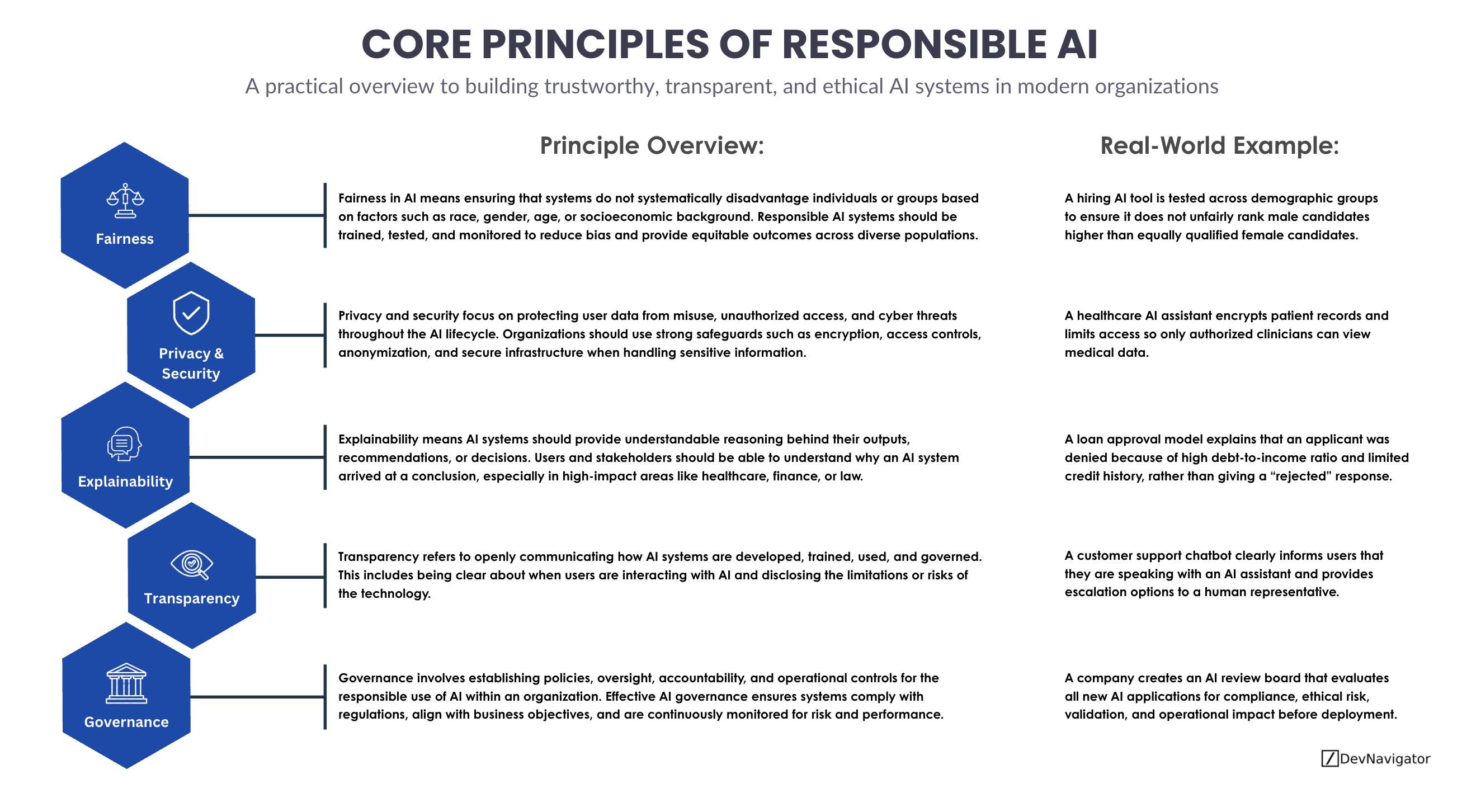
Responsible AI principles are rapidly becoming a core requirement for organizations deploying artificial intelligence at scale. As AI systems move from experimentation into critical business workflows, leaders must ensure these technologies operate fairly, securely, transparently, and under strong governance. Without a clear framework, organizations risk compliance issues, reputational damage, biased decision-making, and loss of user trust.
This article explores five foundational Responsible AI principles that every organization should understand: Fairness, Privacy and Security, Explainability, Transparency, and Governance. Together, these principles summarize technical responsible AI principles to help organizations create AI systems that are not only powerful, but also trustworthy and sustainable for long-term enterprise adoption.
Table of Contents
Executive Takeaways
- Responsible AI principles help organizations reduce operational, ethical, and regulatory risk while increasing trust in AI-driven decisions.
- Fairness, transparency, explainability, privacy, and governance are no longer optional considerations for enterprise AI programs.
- Organizations that operationalize Responsible AI principles early are better positioned to scale AI confidently across business functions.
Expanded Insights
Why Responsible AI Principles Matter
Responsible AI principles are becoming a strategic priority as artificial intelligence expands into healthcare, finance, manufacturing, supply chain, customer service, and regulatory operations. Organizations are no longer evaluating AI solely on performance metrics such as accuracy or speed. They are also evaluating whether AI systems can be trusted.
A technically advanced model that produces biased outcomes, exposes sensitive data, or cannot explain its reasoning may create significant operational and reputational risk. Responsible AI principles provide a framework for balancing innovation with accountability.
For enterprise leaders, the challenge is not simply adopting AI. The challenge is deploying AI systems in a way that aligns with legal requirements, organizational values, and stakeholder expectations.
Fairness and Bias Reduction
Fairness is one of the most widely discussed Responsible AI principles because AI systems can unintentionally inherit biases from training data or historical decision-making patterns. If left unchecked, these biases can influence hiring, lending, insurance, healthcare recommendations, and many other high-impact decisions.
Organizations should continuously evaluate models across demographic groups to identify unequal outcomes or unintended discrimination. This requires diverse datasets, ongoing monitoring, and clear validation procedures throughout the AI lifecycle.
Fairness is not achieved through a single technical control. It is an ongoing operational commitment that combines data quality, testing, governance, and human oversight.
Privacy and Security in Enterprise AI
As AI systems consume larger volumes of enterprise and customer data, privacy and security become foundational Responsible AI principles. Organizations must ensure sensitive information is protected from unauthorized access, misuse, or leakage.
This includes implementing encryption, identity and access management, secure infrastructure, anonymization techniques, and strong cybersecurity practices. AI systems connected to enterprise workflows may also require additional safeguards to prevent accidental exposure of confidential information through prompts, outputs, or integrations.
Security concerns become even more important as organizations adopt AI agents capable of taking actions autonomously across systems and applications.
Explainability and Transparency Build Trust
Many AI models operate as highly complex systems that can be difficult for users to interpret. Explainability helps organizations understand why an AI system produced a recommendation, prediction, or decision.
This is especially important in regulated or high-risk industries where users, auditors, or regulators may require justification for AI-driven actions. Explainability allows stakeholders to validate outcomes, identify errors, and improve confidence in the technology.
Transparency complements explainability by ensuring organizations openly communicate how AI systems are developed, trained, monitored, and used. Users should understand when they are interacting with AI and what limitations or risks may exist.
Together, these Responsible AI principles strengthen trust between organizations, employees, customers, and regulators.
Governance Turns Responsible AI Into an Operational Capability
Governance is often the principle that determines whether Responsible AI succeeds at scale. Without governance, organizations may deploy disconnected AI solutions with inconsistent controls, unclear accountability, and fragmented oversight.
Effective AI governance includes policies, review processes, validation standards, risk assessments, operational monitoring, and executive accountability. Many organizations are now establishing AI review boards or governance councils to evaluate AI initiatives before deployment.
Governance also ensures Responsible AI principles remain active after implementation. AI systems should be continuously monitored for model drift, security risks, fairness concerns, and operational performance over time.
Organizations that treat governance as an operational capability rather than a compliance exercise are more likely to scale AI successfully across the enterprise.
The Future of Responsible AI Principles
Responsible AI principles will continue evolving alongside advances in generative AI, autonomous agents, and enterprise automation. As AI systems become more deeply integrated into critical workflows, expectations around accountability and trust will increase.
The organizations that succeed will not be the ones deploying the most AI. They will be the ones deploying AI responsibly, transparently, and with clear operational controls.
Responsible AI principles are ultimately about enabling sustainable innovation. When implemented correctly, they create the foundation for AI systems that organizations, employees, regulators, and customers can trust.