

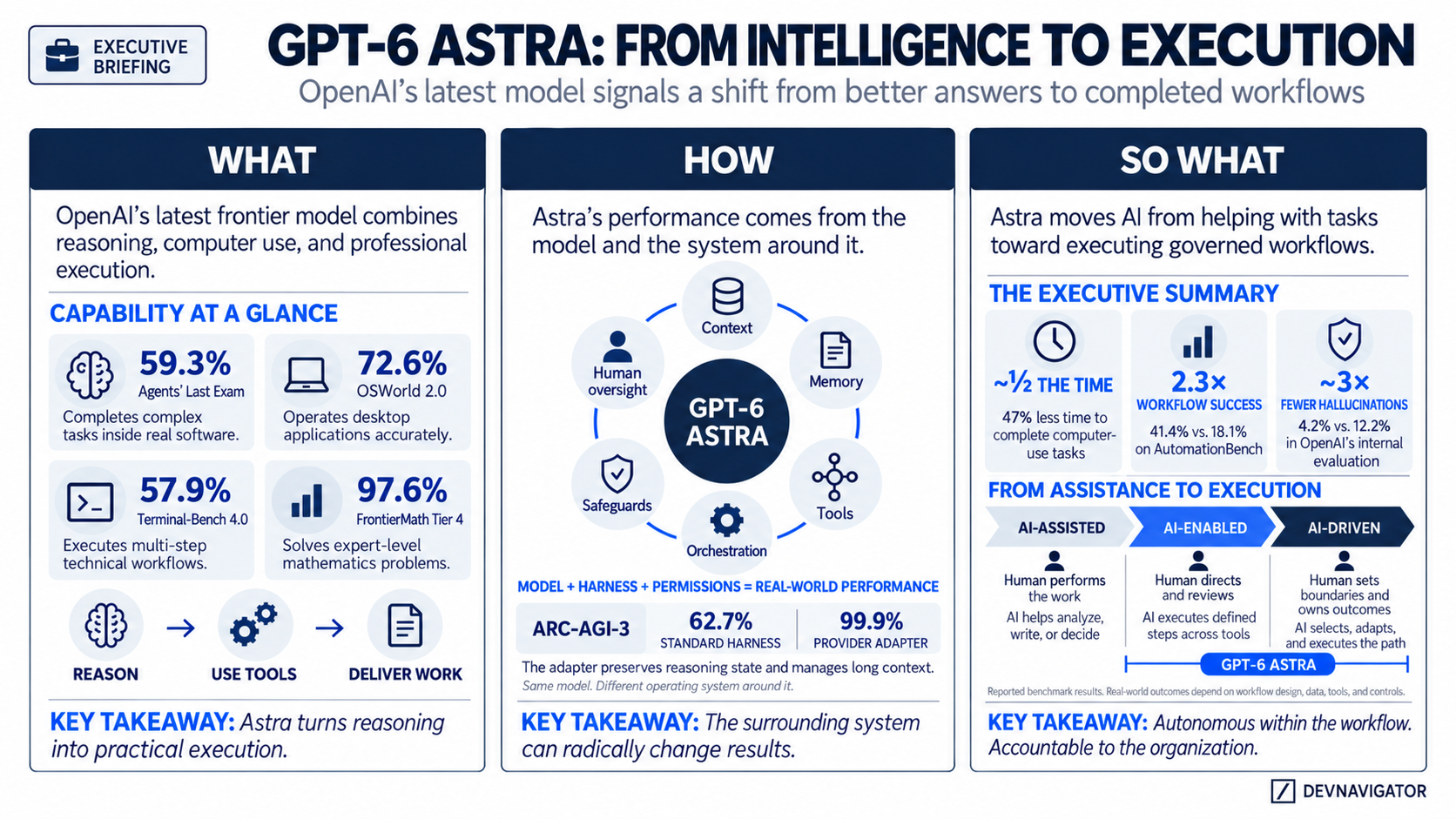
GPT-6 Astra represents an important change in how artificial intelligence creates value. The headline is not simply that the model produces better answers. It can reason through unfamiliar problems, operate software, preserve direction across longer assignments, and complete multistep workflows. Reported benchmark results suggest meaningful improvements in speed, workflow completion, and reliability. For leaders, the larger message is clear: AI is moving from assisting people with individual tasks toward executing governed workflows within defined boundaries.
Table of Contents
Executive Takeaways
- Work can move substantially faster. In OpenAI’s OSWorld latency simulation, GPT-6 Astra completed computer-use tasks in approximately 47% less time than GPT-5.6 Sol.
- Workflow completion improved by more than two times. GPT-6 Astra scored 41.4% on AutomationBench compared with 18.1% for GPT-5.6 Sol, approximately 2.3 times the completion rate on that evaluation.
- The operating system around the model matters. Context, memory, tools, orchestration, permissions, safeguards, and human oversight can radically change how well the same model performs.
Expanded Insights
What Is GPT-6 Astra?
GPT-6 Astra is OpenAI’s latest frontier model, designed for reasoning, computer use, software engineering, science, cybersecurity, and professional work. Unlike a conventional chatbot that primarily generates text, Astra can interact with browsers, terminals, documents, spreadsheets, and specialized applications to produce finished outputs, a major leap forward in comparison to previous models such as GPT-5.4.
The model scored 59.3% on Agents’ Last Exam, which measures professional tasks inside real software. It reached 72.6% on OSWorld 2.0 for desktop application use and 57.9% on Terminal-Bench 4.0 for multistep technical workflows. On FrontierMath Tier 4, it scored 97.6% on expert-level mathematics problems.
These benchmarks measure different capabilities and should not be combined into a single claim of general intelligence. Together, they show stronger reasoning, tool use, and execution across varied digital environments.
How GPT-6 Astra Turns Reasoning Into Action
The model is only one component of the solution. Real-world performance also depends on context, memory, tools, orchestration, permissions, safeguards, and human oversight.
The ARC-AGI-3 results illustrate this clearly. Astra scored 62.7% using ARC Prize’s standard harness and 99.9% using OpenAI’s provider adapter. The adapter preserves reasoning state between requests and manages longer context, allowing the model to reuse prior work. The model remained the same, but the operating system around it changed.
Access to a stronger model does not automatically create stronger business performance. Organizations must design the environment in which it operates.
GPT-6 Astra and the Shift Toward AI-Driven Work
Enterprise adoption spans three operating levels. In AI-assisted work, people perform the task while AI helps. In AI-enabled work, AI executes defined steps while people direct and review. In AI-driven work, people define the objective and boundaries while AI selects and executes the path.
GPT-6 Astra moves organizations further from assisted use toward enabled and increasingly driven execution. Its reported gains make that transition tangible: nearly half the task time, more than twice the workflow-completion rate on AutomationBench, and an internal hallucination rate of 4.2% compared with 12.2% for GPT-5.6 Sol. The last result means nearly three times fewer hallucinations in that specific OpenAI evaluation, not three times greater accuracy everywhere.
What Leaders Should Measure Next
Leaders should ask whether GPT-6 Astra reduces cycle time, increases throughput, lowers cost per completed workflow, and maintains acceptable quality and rework rates.
That is also why GPT-6 Astra should not yet be treated as proof of artificial general intelligence. ARC Prize describes the results as meaningful progress toward generalization but notes that its benchmark remains bounded and does not reproduce the open-ended complexity of the real world.
Competitive advantage will come from combining capable models with connected data, redesigned workflows, clear permissions, measurable controls, and accountable people. GPT-6 Astra may operate autonomously within a workflow, but the organization remains accountable for the outcome.
My Personal Take
AI advances are often surrounded by tremendous noise. Many announcements are useful refinements or new variations on capabilities we already understand. GPT-6 Astra feels different. I generally think about enterprise AI across three levels: AI-assisted, where information goes in and information comes back; AI-enabled, where a request leads to action across data and tools; and AI-led, where the system can determine, adapt, and execute a path toward an objective. Most organizations are still operating primarily in the first category. If Astra’s reported performance translates into real-world environments, it represents a meaningful step toward the second and third. This is certainly not proof of AGI, but it is also not simply another model release like we’ve seen before. It signals that AI is becoming more capable of completing work, and not just contributing or adding guidance to it. That increased capability makes governance more important than ever. Organizations will need to define what the system may access, which decisions it may make, when it must stop, and where human approval remains mandatory. The element of Human-in-the-loop is critical. The goal is not to restrict these models until they lose their value. It is to create clear operating boundaries that allow organizations to use their capabilities confidently, safely, and at scale.