

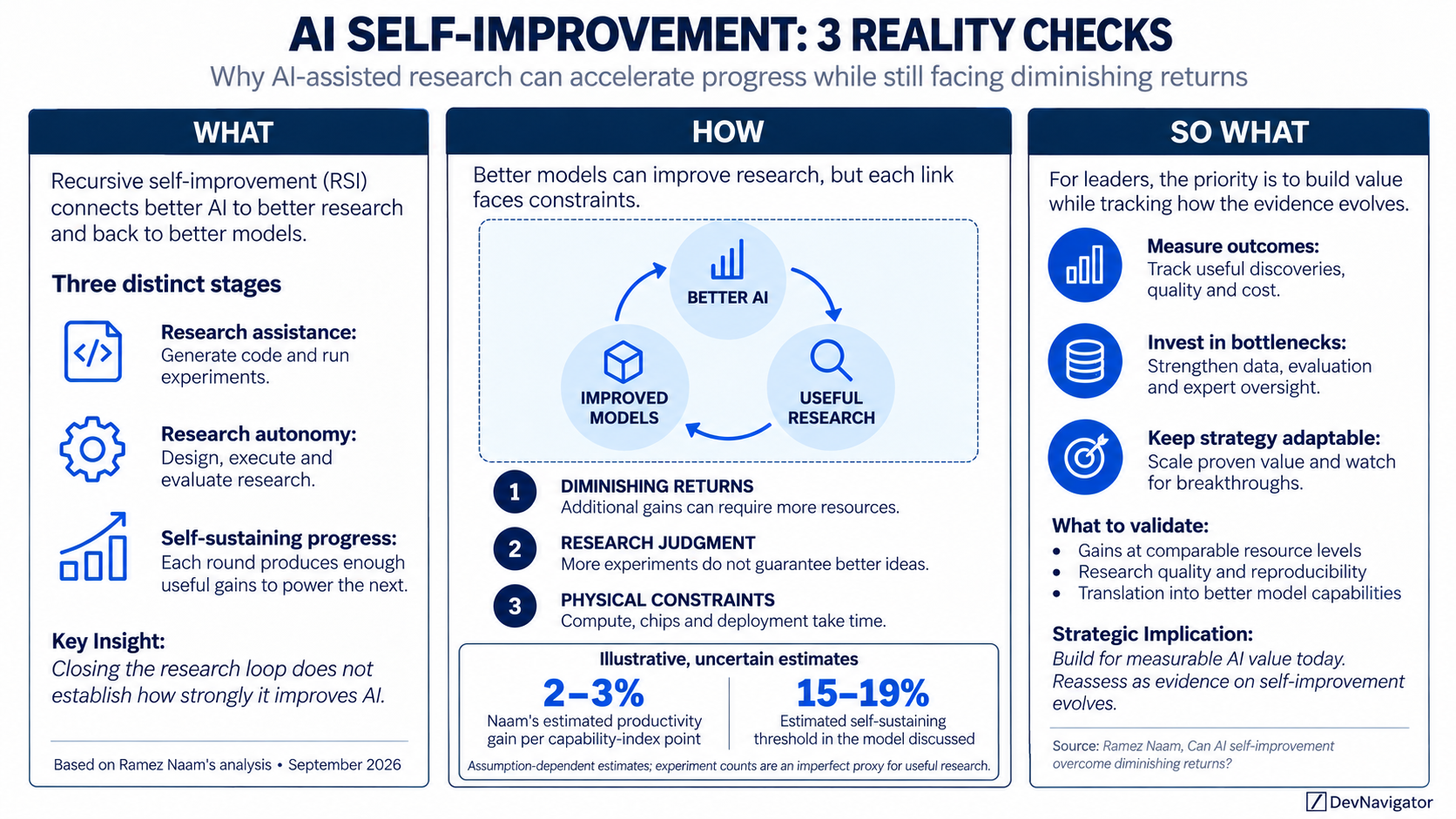
AI self-improvement is becoming a strategic question as models help researchers write code, run experiments, and develop better systems. Ramez Naam argues that these advances do not yet establish a self-sustaining path to general superintelligence. The crucial issue is whether useful discoveries compound fast enough to overcome diminishing returns. For leaders, the debate offers a practical discipline: distinguish assistance from autonomy, measure improvement against resources consumed, and keep investment decisions responsive to evidence. Rapid progress remains possible, even when the software feedback loop cannot sustain itself.
Table of Contents
Executive Takeaways
- Separate the stages. Research assistance, autonomous experimentation, and self-sustaining capability growth represent different achievements with different evidence requirements.
- Measure useful progress. More code, tokens, or experiments create value only when they improve validated outcomes relative to the resources consumed.
- Keep strategy adaptable. Invest in demonstrated business value while monitoring breakthroughs that could change capability growth, costs, and governance needs.
Strategic Insights
AI Self-Improvement Has Three Distinct Stages
The first stage is assistance: AI helps people implement ideas, analyze findings, and execute experiments. The second is autonomy: a system manages more of the research cycle, from proposing an intervention to testing its results. The third is self-sustaining improvement: each cycle generates enough useful progress to support further gains.
These stages should shape how leaders interpret announcements. An agent completing a research workflow demonstrates execution capability. Establishing that the resulting discoveries reliably make its successor more capable requires additional measurement.
In his analysis of recursive self-improvement, Naam challenges the assumption that automating research necessarily produces a rapid intelligence explosion. His argument concerns the strength of the feedback loop, rather than whether AI can contribute to research.
Diminishing Returns Can Weaken the Loop
AI self-improvement depends on a chain: better models enable useful research, useful research improves models, and those models improve the next research cycle. Weakness at any link limits the combined effect.
The Economics of Recursive Self-Improvement paper models these feedback relationships and distinguishes narrow research capabilities from broader economically useful capabilities. Its preliminary calibration suggests current feedback is insufficient for self-sustaining acceleration, while acknowledging that the loops appear to be strengthening.
Naam offers a separate working estimate of roughly 2–3% additional research productivity per point on Epoch’s capability index, compared with an estimated 15–19% self-sustaining threshold in the model he discusses. These figures are assumption-dependent estimates. They are neither universal thresholds nor direct measurements of distance to superintelligence.
For AI self-improvement, the measurement challenge matters as much as the headline comparison. Experiment counts may miss better ideas, higher-quality results, or differences in compute availability. Future evidence could materially change the conclusion.
Research Judgment and Infrastructure Still Matter
Automating experiments increases the number of possibilities a team can explore. The harder question is whether the system selects valuable questions, recognizes misleading results, and develops ideas that generalize.
DevNavigator’s discussion of automated alignment research illustrates why evaluation and human responsibility remain central when agents conduct research. Leaders need confidence that an improvement survives independent testing and reflects the intended objective.
AI self-improvement also interacts with physical infrastructure. Better software can help design chips or use compute more efficiently, but manufacturing, construction, and deployment introduce delays. Capital investment and hardware advances can support continued rapid progress even when the software loop alone is insufficient.
Build Strategy Around Evidence That Can Change
For enterprise leaders, AI self-improvement should inform scenario planning without becoming an assumed delivery timeline. A sound investment should create value under the capabilities available today and remain useful as those capabilities improve.
Apply the same discipline internally. When an agent optimizes a manufacturing schedule, evaluates software, or proposes process changes, measure validated quality, cost, and reliability. Compare performance at similar resource levels and investigate whether gains persist outside the original evaluation.
Assign ownership for accepting results and deciding when to expand autonomy. Preserve experiment histories, independent evaluations, and clear escalation paths so increased activity produces trustworthy organizational learning.
The leadership implication of AI self-improvement is to scale demonstrated value and revisit assumptions as evidence changes. Better research judgment, stronger feedback, or major architectural advances could shift the outlook. Strategy should make those changes visible early enough to act.