

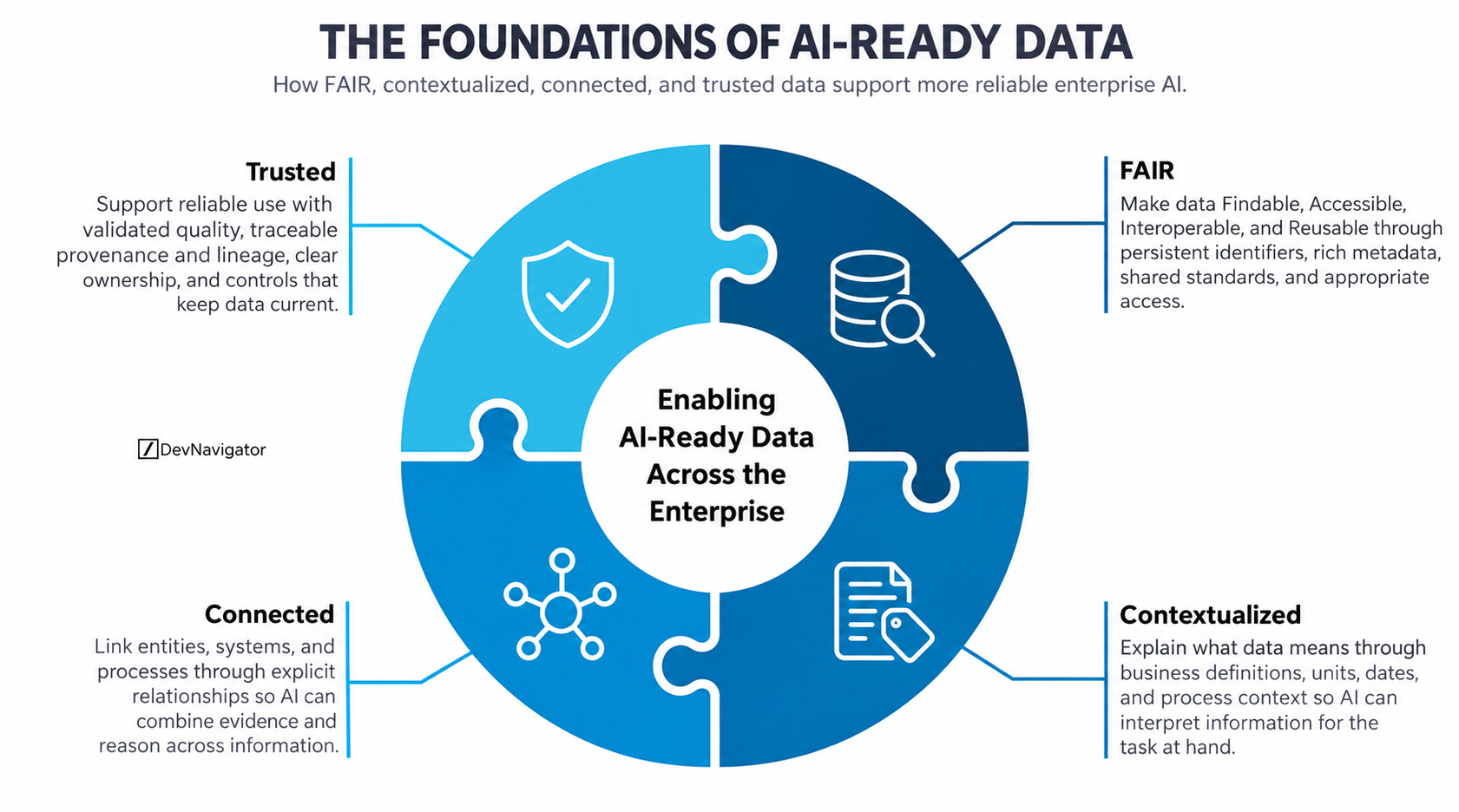
AI-ready data gives enterprise AI the information it needs to discover relevant evidence, interpret business meaning, connect relationships, and assess reliability. Better models still depend on the information available to them when answering a question or supporting a decision. Four complementary foundations offer a practical way to organize that work: FAIR, contextualized, connected, and trusted data. These foundations overlap and form a management framework rather than a formal standard. For leaders, the priority is to build them around specific business tasks and measure whether they improve the resulting answers.
Table of Contents
Executive Takeaways
- Build the foundations together. AI-ready data combines discoverability, meaning, relationships, and trust to support useful enterprise decisions.
- Preserve business meaning. Definitions, time periods, process context, and explicit relationships help AI interpret evidence without relying on assumptions.
- Measure readiness through outcomes. Evaluate answer accuracy, traceability, freshness, and appropriate access against the tasks the system must perform.
Strategic Insights
1. FAIR: Make AI-ready data discoverable and reusable
The FAIR Guiding Principles describe data that is Findable, Accessible, Interoperable, and Reusable. Persistent identifiers, searchable metadata, shared vocabularies, and clear usage conditions help people and machines locate and reuse information.
For an enterprise, this means an agent can discover an approved dataset, understand its structure, and retrieve it through a supported interface. Accessibility includes authentication and authorization when needed; sensitive information can remain protected.
Consider a manufacturing assistant searching for batch performance. A spreadsheet on someone’s desktop may contain useful facts, but a described, indexed dataset with stable identifiers is easier to discover and use consistently. AI-ready data starts with making valuable information available to the right consumer.
2. Contextualized: Explain what the information means
A number becomes useful when its meaning is clear. Yield of 92% requires a product, site, process stage, calculation method, and reporting period before it supports a meaningful comparison.
Contextualization supplies those details through definitions, units, timestamps, business rules, and supporting descriptions. It also preserves the background that can disappear when documents are split into fragments for retrieval.
Anthropic’s Contextual Retrieval adds explanatory context to fragments before indexing. In its reported experiments, combining contextual retrieval with reranking reduced top-20 retrieval failures from 5.7% to 1.9%. That is a retrieval result, not a guarantee of equivalent improvement in answer accuracy.
For leaders, the implication is practical: fund the business definitions and process knowledge that make AI-ready data interpretable, alongside the infrastructure that stores it.
3. Connected: Make relationships explicit
Business questions often span systems. Investigating a delayed shipment might require connections among an order, product, batch, quality release, manufacturing site, and supplier.
Connected data makes these relationships explicit through consistent identifiers, governed joins, semantic models, or knowledge graphs. The objective is to let the system follow relevant relationships and assemble evidence across organizational boundaries.
DevNavigator’s discussion of enterprise MCP patterns explores how agents access capabilities across systems. That access becomes more useful when the underlying data has consistent meaning and relationships.
A graph database is one implementation option. Simpler relational approaches may be sufficient. Invest in the connections required by a valuable business question, then test whether they improve completeness and correctness.
4. Trusted: Keep evidence reliable and accountable
AI-ready data needs an accountable source, validated quality, traceable transformations, and clear ownership. A well-described dataset can still be stale, incomplete, or unsuitable for a particular decision.
Trust therefore requires operating practices: quality checks, freshness expectations, version history, access controls, and a named owner who resolves issues. Generated summaries and extracted relationships should retain their supporting sources and undergo validation before becoming reusable evidence.
Improvement over time comes from a managed feedback process. Investigate failed answers, correct definitions or records, adjust retrieval, and validate reusable lessons. Adding context changes the information a system uses; it does not automatically retrain the model.
Start with one decision, assign owners across the four foundations, and establish a baseline. Measure whether changes improve answers, source traceability, retrieval coverage, and handling of uncertainty. Scale AI-ready data practices where the evidence shows value, with AI and data teams sharing responsibility for the outcome.