

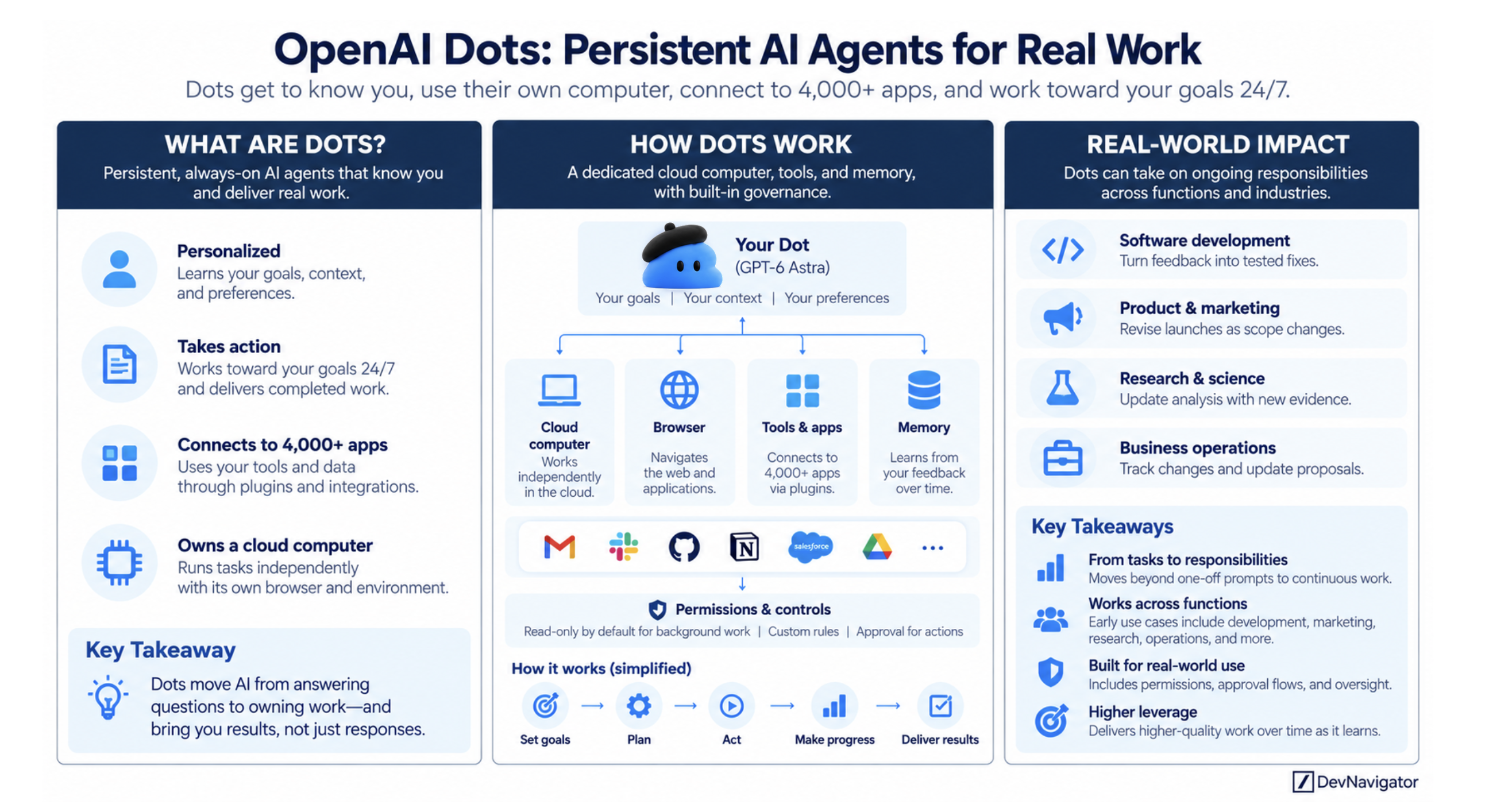
OpenAI Dots represent the next evolution of agentic AI: persistent agents that can understand goals, use computers and applications, learn from feedback, and continue working over time. The opportunity for enterprises is not simply better automation, but a new way to divide responsibilities between people and AI.
Table of Contents
Executive Summary
- OpenAI Dots introduce persistence. Instead of waiting for the next prompt, a Dot can take on ongoing responsibilities and continue making progress between conversations.
- They combine intelligence with an execution environment. Dots are powered by GPT-6 Astra, have their own cloud computer, and can work across connected applications. OpenAI Help Center
- The strategic shift is from tasks to responsibilities. Leaders can begin thinking beyond isolated AI use cases toward persistent workflows with goals, permissions, review points, and measurable outcomes.
Strategic Insights
WHAT: AI That Keeps Working
For most of the generative AI era, interacting with AI has followed a simple pattern: prompt, response, stop. A person identifies a need, asks the model to perform a task, reviews the output, and decides what happens next. Even increasingly capable AI assistants have largely depended on humans to initiate each new interaction.
OpenAI Dots introduce a fundamentally different model. A Dot is an always-on AI agent designed to understand what matters to you and continue working toward your goals. Instead of starting from scratch with every conversation, it can develop an understanding of your goals, context, preferences, applications, and standards, then use that context as it continues working over time.
The distinction is persistence. OpenAI describes scenarios where a developer’s Dot monitors customer feedback, identifies recurring problems, builds and tests fixes, and returns completed pull requests for review. A scientist’s Dot can respond when new experimental data arrives, rerun analyses, update figures, and flag findings requiring attention. A product leader’s Dot can revise launch materials when product requirements change, while a commercial Dot can keep proposals synchronized as customer requirements evolve.
These examples share the same underlying pattern. The human establishes an objective, but does not necessarily need to initiate every intermediate step. Instead of Prompt → Response → Stop, the operating model starts to resemble Goal → Plan → Act → Learn → Continue.
That is what makes Dots strategically interesting. They move AI beyond answering questions and toward owning pieces of work.
HOW: Intelligence Becomes an Execution System
The architecture behind OpenAI Dots is just as important as the interface. GPT-6 Astra provides the underlying intelligence, but intelligence alone does not create an autonomous worker. An agent also needs somewhere to work, access to the systems required to perform that work, context about what it is trying to accomplish, and boundaries around what it is allowed to do.
Dots combine those components into a persistent execution environment. Each Dot has its own cloud computer and browser, allowing it to navigate applications and perform multi-step digital work. OpenAI’s plugin ecosystem provides connectivity to more than 4,000 applications, creating a path for agents to interact with the tools and information that already surround a user’s work.
Conceptually, the architecture can be thought of as Intelligence → Computer → Tools → Context → Action. GPT-6 Astra provides reasoning. The cloud computer and browser provide an execution environment. Plugins connect the agent to applications and information. Persistent context gives the agent an understanding of goals and preferences. Together, those capabilities allow the system to move from determining what should happen to actually performing the work.
Feedback adds another important layer. As users review results and provide direction, a Dot can develop a better understanding of what good work looks like for that person. The goal is not simply to remember information, but to improve how the agent approaches future work. Over time, the interaction becomes less about repeatedly explaining individual tasks and more about establishing expectations for an ongoing working relationship.
This produces a relatively simple operating loop: set the goal, plan the work, take action, make progress, and deliver results. The technology underneath that loop may be sophisticated, but the experience OpenAI Dots is pursuing is intentionally much simpler: give the agent something meaningful to own and intervene when your judgment is needed.
HOW: More Autonomy Requires More Governance
Giving AI access to computers and enterprise applications creates considerably more value than generating text alone, but it also increases the potential consequences of mistakes. An incorrect paragraph can be edited. An incorrect action taken inside a financial, commercial, or operational system can have a much larger impact.
Governance therefore becomes part of the architecture rather than something added afterward. Dots include permissions, Custom Rules, approval mechanisms, monitoring, and action review designed to determine what an agent can do independently and where human involvement is required. OpenAI’s proactive research capability is deliberately more constrained: a Dot can examine permitted information in the background and identify ways it might help, but those background tools operate with read-only restrictions.
This suggests an important principle for enterprise AI. The objective should not necessarily be maximum autonomy, but appropriate autonomy. Some activities can safely operate in the background. Others should require verification before execution. High-impact decisions may need explicit human approval regardless of how capable the underlying model becomes.
As persistent agents become more common, identity, permissions, observability, verification, and escalation will become increasingly important components of enterprise AI architecture. The most useful agent may not be the one allowed to do everything. It may be the one given precisely enough authority to reliably own a well-defined responsibility.
SO WHAT: A New Layer of Digital Labor
OpenAI is already extending this idea beyond personal agents through its preview of specialist Dots for organizations. These agents are designed around specific organizational responsibilities and can have their own identities, credentials, permissions, and access to enterprise systems. OpenAI has described early work spanning procurement, invoice processing, customer support, email marketing, and commercial contracting.
This points toward a future enterprise architecture that looks very different from simply giving every employee an AI chatbot. Organizations could eventually operate portfolios of persistent agents, each responsible for a particular workflow or outcome. One might support procurement, another monitor operational performance, another maintain software, and another support commercial activities.
The role of people does not disappear in this model. It changes. Humans increasingly define objectives, establish constraints, review exceptions, approve consequential decisions, and remain accountable for outcomes. AI takes on more of the continuous coordination and execution that sits between those decisions.
Seen through that lens, the progression of enterprise AI becomes clearer. Chatbots automated interactions. Agents began automating workflows. Persistent agents begin automating responsibilities.
The Leadership Takeaway
OpenAI Dots should not simply be viewed as another AI product launch. They are part of a broader transition in how work can be delegated between humans and machines. The strategic question for leaders is gradually shifting from “What tasks can we automate?” toward “What responsibilities could an AI agent continuously own?”. This is where OpenAI Dots come into play.
The strongest candidates will likely be responsibilities with recurring work, clear objectives, accessible digital systems, measurable outcomes, predictable boundaries, and well-defined points for human escalation. That means leaders building an AI portfolio should begin looking beyond inventories of individual use cases and start identifying areas of the organization where persistent ownership could create leverage.
The organizations that gain the greatest advantage may not be those that deploy the largest number of agents. They may be the ones that become best at determining what AI should own, what people should oversee, and where the boundary between the two belongs.