

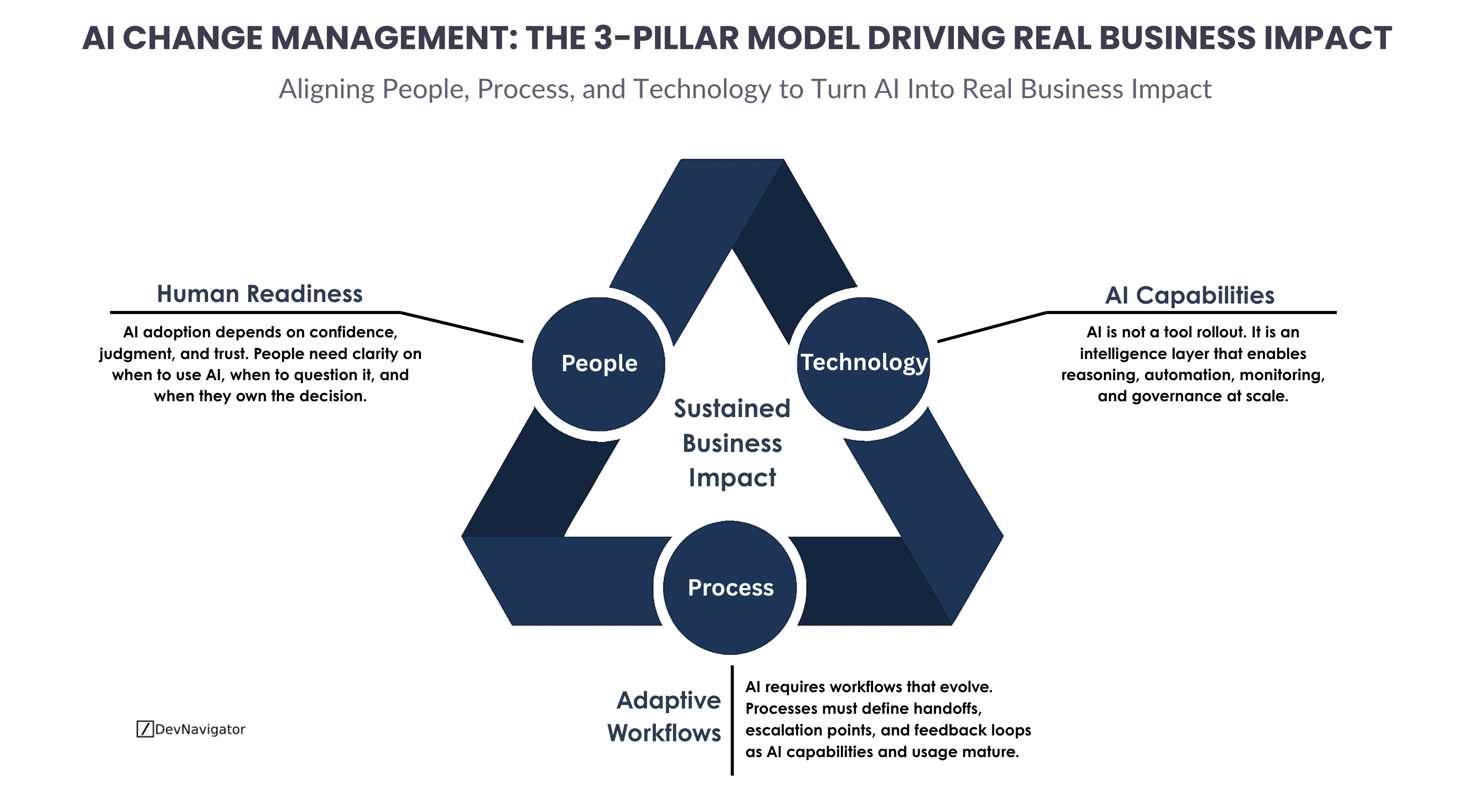
AI change management is often treated as a technology rollout problem. In practice, that framing is what causes most AI initiatives to stall. Real AI change management is about aligning people, process, and technology around sustained business impact. When one of these pillars moves faster than the others, organizations end up with pilot fatigue, low trust, or fragile systems that never scale. This article introduces a common simple but durable AI change management pyramid that places value at the center and explains why alignment, not speed, determines long-term success.
Table of Contents
Executive Takeaways
- AI change management succeeds when people, process, and technology evolve together rather than independently.
- Sustainable value emerges only when trust, workflow design, and AI capabilities are deliberately aligned.
- Organizations that treat AI as an operating model shift, not a tool rollout, scale impact faster and more reliably.
Expanded Insights
Why AI Change Management Breaks Traditional Models
Most change frameworks were built for static systems. New software was deployed, people were trained, and processes were updated once. AI does not behave this way. AI systems learn, drift, improve, and occasionally fail in unpredictable ways. This makes AI change management fundamentally different from past digital transformations.
Treating AI as just another technology implementation creates a mismatch. Technology advances quickly, while people and processes lag behind. The result is hesitation, workarounds, and shadow usage. Effective AI change management starts by recognizing that all three pillars must move in sync.
People: Human Readiness as the First Constraint
In AI change management, people are rarely the problem, but they are often the constraint. Most resistance is not ideological. It comes from uncertainty. Teams are unsure when to rely on AI, when to question it, and who is accountable when outcomes matter.
Human readiness focuses on confidence, judgment, and trust. This includes basic AI literacy, but more importantly, it includes clarity of ownership. People need to know that AI supports decisions, not replaces responsibility. When this clarity exists, adoption accelerates naturally. When it does not, even the best AI systems remain underused.
Process: Designing for Adaptation, Not Stability
AI does not fit neatly into fixed workflows. Processes designed for predictable systems struggle when AI recommendations evolve over time. AI change management therefore requires adaptive workflows.
Adaptive workflows define where AI participates, where humans intervene, and how feedback is captured. They include escalation paths, review checkpoints, and learning loops that allow processes to mature as AI usage grows. Without this structure, AI either becomes overtrusted or ignored. Both outcomes limit value. Strong process design turns AI into a repeatable capability rather than a collection of one-off use cases.
Technology: From Tools to AI Capabilities
One of the most common AI change management mistakes is treating technology as a single deployment event. In reality, AI is an ongoing capability layer. It includes models, data pipelines, monitoring, governance, and lifecycle management.
Effective AI capabilities enable reasoning, automation, performance tracking, and risk controls at scale. They make AI reliable enough for daily operations rather than experimental use. Organizations that invest only in front-end tools often discover that value erodes quickly without this foundation. Technology enables scale, but only when it is operated, not just installed.
Value at the Center: Where Alignment Pays Off
The center of the pyramid is sustained business impact. This is where AI change management either proves itself or fails. Value is created when people trust AI, processes adapt to it, and technology performs consistently.
This value shows up in practical ways. Faster decisions, reduced rework, improved consistency, and reclaimed time. When these outcomes are visible, adoption becomes self-reinforcing. Teams pull AI into their work instead of being pushed toward it. AI change management succeeds when value compounds over time rather than appearing only in isolated pilots.
The Real Goal of AI Change Management
The goal is not faster deployment. It is durable alignment. Organizations that approach AI change management as a system, not a project, build momentum that lasts beyond any single model or platform. When people, process, and technology move together, AI stops being a novelty and becomes part of how work gets done.