

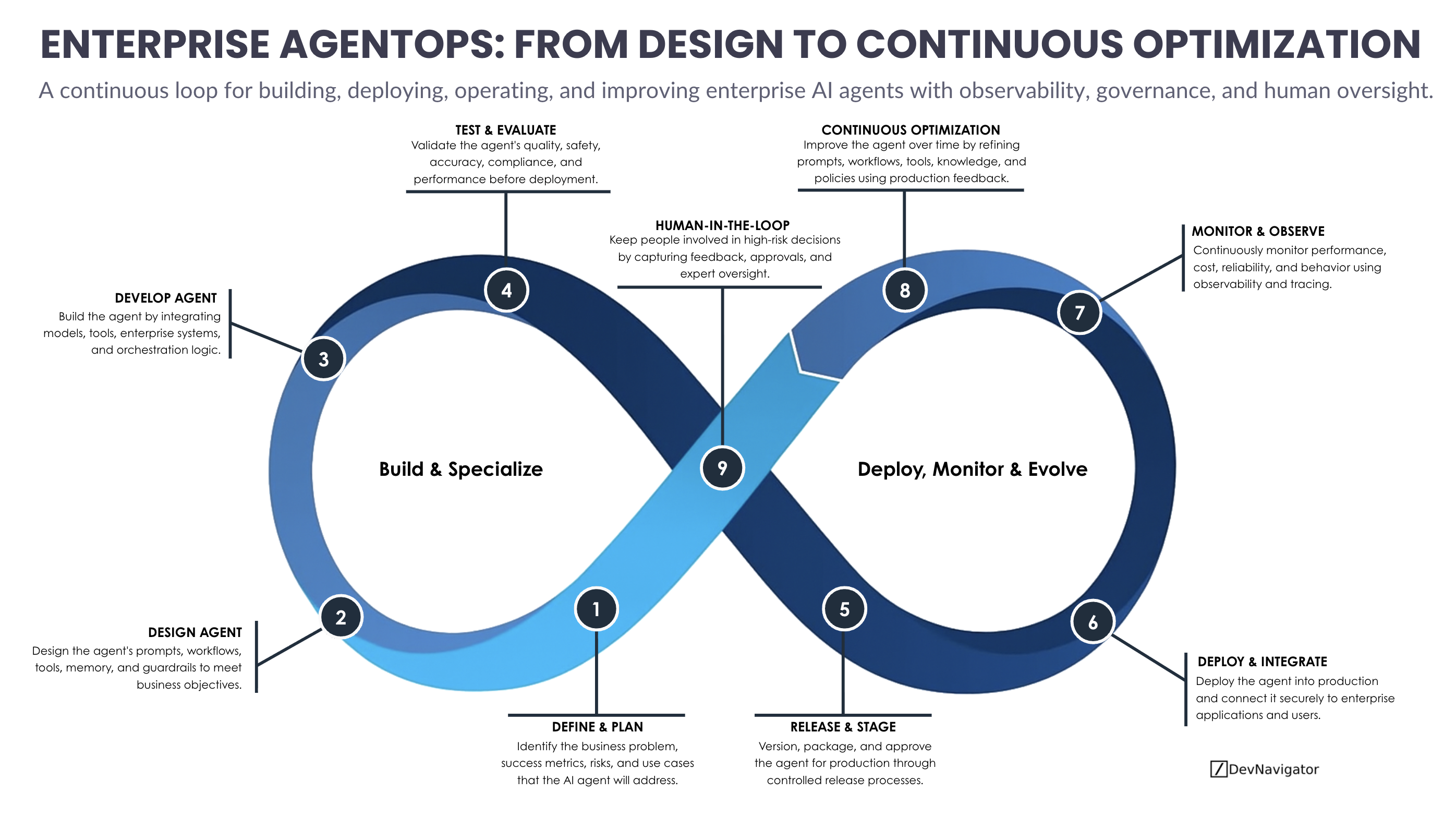
Enterprise AgentOps is becoming the operational foundation for production AI agents. Building an agent is only the beginning. Organizations also need processes for testing, deployment, monitoring, governance, and continuous improvement to ensure agents remain reliable, secure, and aligned with business goals. The lifecycle shown above illustrates how Enterprise AgentOps connects these capabilities into a continuous operating model that supports AI systems from initial planning through long-term optimization.
Table of Contents
Executive Takeaways
- Enterprise AgentOps is a lifecycle, not a deployment step. Successful AI agents require continuous planning, testing, monitoring, governance, and optimization after they go live.
- Observability and human oversight are essential. Production agents should be monitored for performance, reliability, and safety while allowing experts to review high-risk decisions.
- Continuous improvement creates long-term value. Production feedback should drive prompt updates, workflow improvements, policy refinement, and knowledge expansion rather than treating deployment as the finish line.
Expanded Insights
Enterprise AgentOps Begins Before Development
Many AI projects start by selecting a model or writing prompts. Enterprise AgentOps starts much earlier by defining the business problem. Organizations first identify the use case, establish success metrics, understand risks, and determine where an AI agent can provide measurable value.
Once the objectives are clear, the agent is designed around those requirements. This includes prompts, workflows, memory strategy, tool selection, and guardrails. These design decisions determine how the agent behaves long before a single line of production code is written.
Development then brings those designs to life by integrating foundation models with APIs, enterprise systems, retrieval mechanisms, and orchestration logic. The result is an operational AI agent that can perform useful work instead of simply generating responses.
Validation Before Production
A production agent should never move directly from development into deployment. Testing is a core stage of Enterprise AgentOps because AI systems introduce new risks that traditional software testing often misses.
Evaluation should measure more than technical correctness. Organizations should validate response quality, factual accuracy, safety, compliance, workflow execution, latency, and performance under realistic operating conditions. Benchmarking and adversarial testing can also identify edge cases before they affect users.
Only after these evaluations are complete should an organization package, version, approve, and stage an agent for production. Controlled releases reduce operational risk while making future updates easier to manage.
Operating AI Agents Requires Continuous Visibility
Deployment is the beginning of the operational lifecycle, not the end. Once an agent enters production, Enterprise AgentOps shifts its focus toward operational excellence.
Agents should be integrated securely with enterprise applications while maintaining appropriate identity, authentication, and permissions. Observability then provides continuous visibility into system health by measuring response quality, latency, reliability, operational cost, and behavioral trends.
This level of monitoring helps organizations detect failures, identify unexpected behavior, and understand how agents perform under real workloads. Traceability and auditability also become increasingly important as AI systems support regulated business processes.
Continuous Optimization Keeps Agents Effective
Business environments evolve constantly. Policies change, knowledge becomes outdated, and user expectations shift over time. Enterprise AgentOps recognizes that AI agents must evolve alongside the organization.
Production feedback provides valuable insights for refining prompts, improving workflows, expanding knowledge sources, and updating operational policies. Many improvements occur without retraining the underlying foundation model, allowing organizations to improve performance through better orchestration and operational practices.
Human oversight remains an important part of this process. Experts review high-risk actions, approve sensitive decisions, and provide feedback that improves future agent behavior. Keeping people involved where judgment matters helps balance automation with accountability.
Enterprise AgentOps Creates Sustainable AI Operations
As organizations deploy larger numbers of AI agents, managing them individually becomes increasingly difficult. Enterprise AgentOps provides a repeatable operating model that standardizes development, deployment, governance, monitoring, and continuous improvement across the enterprise.
The lifecycle is supported by capabilities that span every stage, including governance, security, access management, compliance, privacy, and risk management. These capabilities are not isolated activities but continuous responsibilities that help ensure AI agents remain secure, reliable, and aligned with business objectives.
Organizations that embrace Enterprise AgentOps are better positioned to move beyond isolated proofs of concept and establish AI agents as dependable components of everyday business operations. Rather than viewing deployment as the finish line, they treat every production interaction as an opportunity to learn, improve, and deliver greater value over time.