

Many organizations approach AI by automating individual tasks, deploying chatbots, or experimenting with new models. While these efforts can generate short-term wins, they often fail to produce lasting business value. The reason is simple: AI adoption is not primarily a technology challenge. It is a transformation challenge.
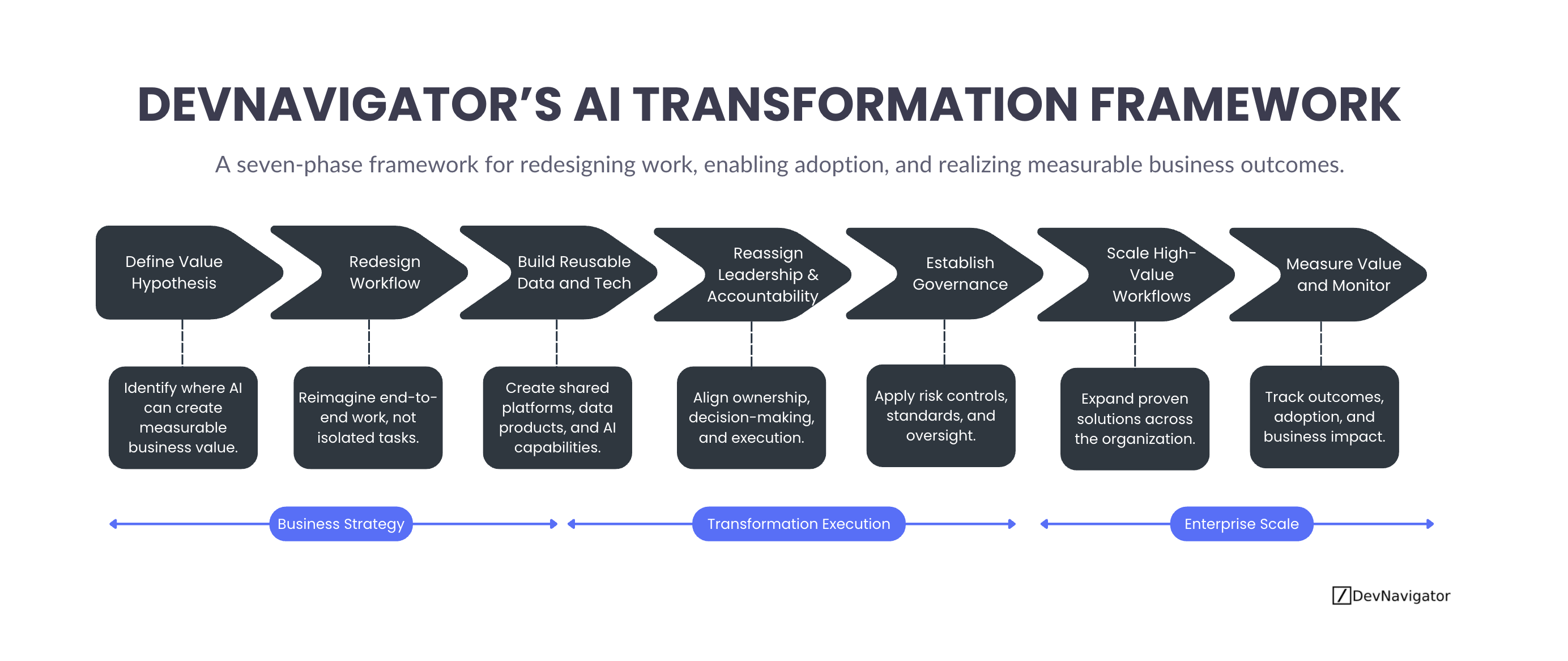
The AI Transformation Framework provides a structured seven-phase approach for identifying value, redesigning work, building reusable capabilities, establishing governance, and scaling successful solutions across the enterprise. Rather than focusing on isolated tools, the framework focuses on how work is performed, who owns outcomes, and how organizations sustain change over time.
Organizations that follow a disciplined AI Transformation Framework are better positioned to achieve measurable improvements in productivity, quality, speed, and decision-making.
Table of Contents
Executive Takeaways
- AI transformation begins with business value, not technology. Organizations should first identify measurable outcomes before selecting models, platforms, or tools.
- Workflow redesign creates more value than task automation. The largest gains come from rethinking end-to-end processes rather than optimizing individual activities.
- Governance and accountability are essential for scale. Sustainable AI transformation requires clear ownership, risk controls, adoption metrics, and ongoing monitoring.
Expanded Insights
Phase 1: Define the Value Hypothesis
Every successful AI Transformation Framework starts with a clear value hypothesis.
Before building solutions, organizations should identify where AI can create measurable business impact. Examples include reducing cycle times, improving customer experience, lowering operational costs, increasing throughput, or improving decision quality.
This phase establishes the business case and prevents teams from pursuing AI simply because the technology is available. If a use case cannot be tied to a measurable outcome, it is unlikely to receive long-term support or investment.
Phase 2: Redesign the Workflow
Many organizations attempt to automate existing tasks without questioning how the work should be performed.
The AI Transformation Framework emphasizes redesigning the entire workflow. Instead of asking how AI can improve one step, leaders should examine the full process from beginning to end.
For example, reducing the time required to write a report may offer limited value if approvals, data collection, and decision-making remain unchanged. Reimagining the entire workflow often reveals larger opportunities for automation, simplification, and human-machine collaboration.
This phase frequently produces the largest business gains.
Phase 3: Build Reusable Data and Technology Foundations
AI projects often fail because teams repeatedly solve the same technical problems.
A strong AI Transformation Framework focuses on creating reusable assets that support multiple use cases. These may include shared data products, AI platforms, APIs, knowledge repositories, governance controls, and integration capabilities.
Building once and reusing many times reduces implementation costs and accelerates future deployments. Organizations that establish common foundations can scale much faster than those building isolated solutions for every project.
Phase 4: Reassign Leadership and Accountability
Technology alone does not transform organizations.
As workflows change, ownership structures often need to change as well. Decision-making authority, performance metrics, operational responsibilities, and accountability models should align with the new way of working.
The AI Transformation Framework recognizes that transformation succeeds when leaders actively own outcomes rather than treating AI as a separate technology initiative.
Without clear ownership, even technically successful solutions struggle to gain adoption.
Phase 5: Establish Governance
As AI adoption increases, governance becomes increasingly important.
Organizations need standards, oversight mechanisms, risk controls, validation processes, and compliance practices that match their industry and regulatory environment.
Governance should not be viewed as an obstacle to innovation. Effective governance enables responsible scaling by ensuring that solutions remain reliable, transparent, and aligned with organizational objectives.
A mature AI Transformation Framework balances innovation with appropriate oversight.
Phase 6: Scale High-Value Workflows
Once a solution has demonstrated value, the next challenge is expansion.
Many organizations successfully complete pilots but fail to scale them. The AI Transformation Framework focuses on identifying proven workflows and systematically extending them across departments, business units, and geographies.
Scaling should prioritize repeatable value creation rather than deploying AI everywhere. The goal is to expand successful patterns that have already demonstrated measurable business benefits.
Phase 7: Measure Value and Monitor Performance
Transformation is never complete.
The final phase of the AI Transformation Framework focuses on tracking outcomes, adoption, operational performance, and business impact over time.
Organizations should monitor key metrics such as productivity improvements, cost savings, quality improvements, cycle-time reductions, user adoption, and risk indicators.
Measurement creates accountability and helps leaders determine whether AI investments are delivering their intended outcomes. It also provides the feedback needed to continuously improve workflows and identify new opportunities for transformation.
From Strategy to Enterprise Scale
The seven phases naturally group into three broader stages.
The first two phases focus on business strategy by identifying value and redesigning work. The middle phases focus on transformation execution through technology, leadership alignment, and governance. The final phases focus on enterprise scale by expanding successful solutions and measuring long-term impact.
This progression is what makes the AI Transformation Framework practical. It recognizes that technology deployment is only one component of transformation. Sustainable success comes from aligning business objectives, workflows, people, governance, and measurement into a single operating model.
Organizations that approach AI through this lens are far more likely to move beyond experimentation and achieve meaningful business outcomes.